
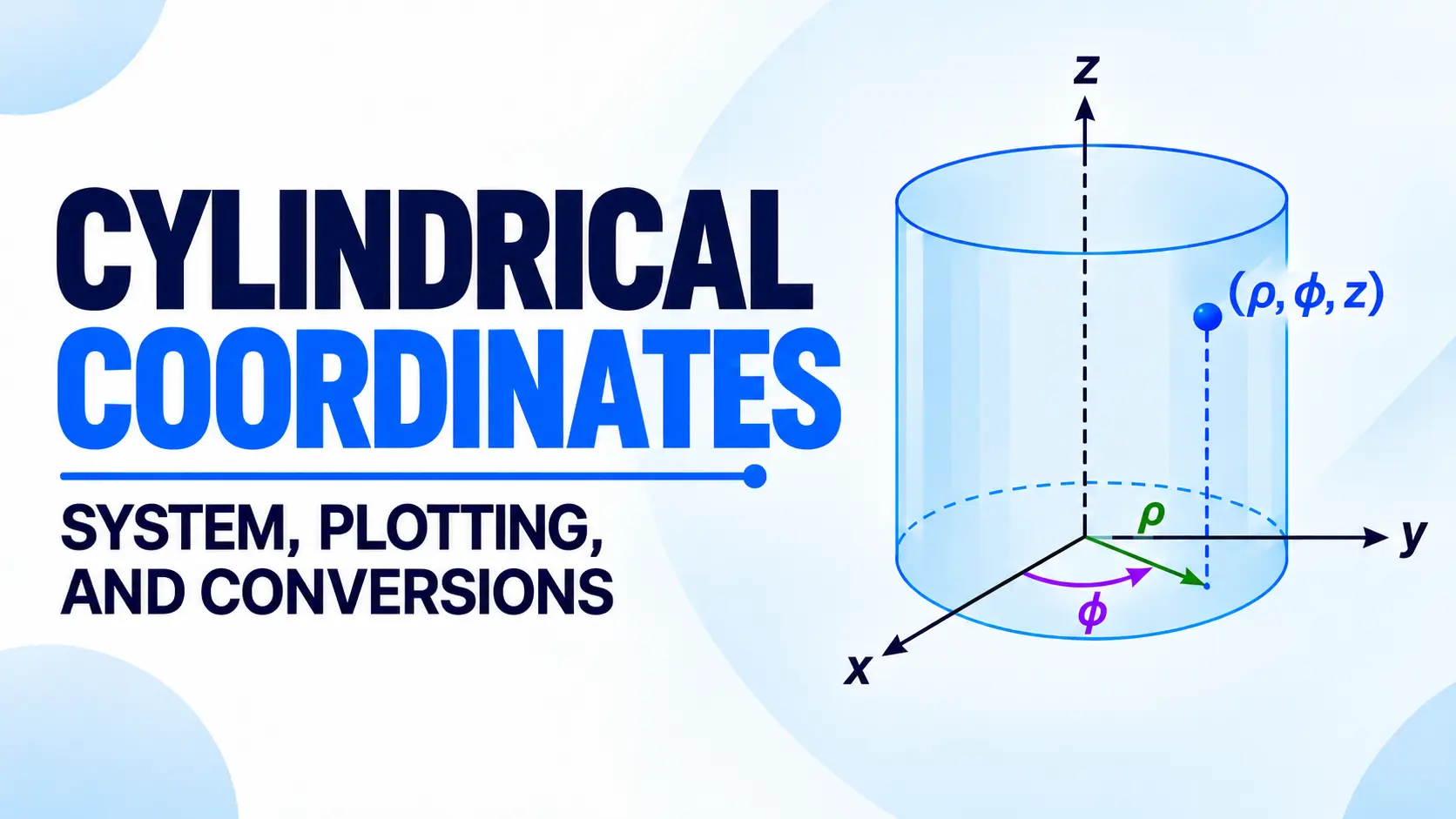
While discussing cylindrical coordinates, I start with polar coordinates, which already use r (or ρ) and θ (or φ), and then add one more value, z, for height. That small step creates the cylindrical coordinate system, a clean way to describe 3D space.
Imagine a point inside a cylindrical pipe. You can describe where it is with three measurements:
- How far it is from the pipe’s middle, ρ (or r)
- How far around the pipe it is, θ (or φ)
- How far along the pipe it is, z
Together, these three measurements locate the point P. In Physics and engineering, this way of describing a point can simplify messy equations when something has a circular shape or spins around an axis. It may be simpler than using the usual x, y, and z coordinates.
In this article, we’ll explore the cylindrical coordinate system and learn how coordinates in it represent the position of a point. We’ll discuss how to plot points and convert between different coordinate systems. Finally, we’ll explain how to represent vectors in cylindrical coordinates.
What is the Cylindrical Coordinate System? (Definition)
A cylindrical coordinate system pins down every point in space using ordered triples (ρ,φ,z). Think of it as polar coordinates stretched into a 3D coordinate system, a natural extension of the 2D plane.
In my own work, I read it as three simple moves: take the radial distance ρ, turn through an angle φ measured from the polar axis, then lift by height z, a signed distance from the xy-plane. Try ρ = 3, φ = π/4, z = 5: three units out, forty-five degrees around, five up.
Where Cartesian coordinates treat x and y identically, this setup honors rotational symmetry about the z-axis, which is why pipe flow and other cylinder problems feel easier here.
Cylindrical Coordinate System Framework
The cylindrical coordinate system consists of some elements that work together to plot cylindrical coordinates.
- Origin (or Pole): The origin is the fixed spot from which every measurement starts, so nothing gets placed before it. It has coordinates (0,0,0).
- Cylindrical axis: The cylindrical axis, the vertical z-axis, also called the main axis or longitudinal axis, runs through the origin vertically.
- Reference plane: The reference plane is the horizontal xy-plane, which cuts the axis perpendicularly at the origin.
- Polar axis or reference direction: The reference direction is the positive x-axis lying in the reference plane. The azimuthal angle φ is zero at the polar axis or reference direction and increases counterclockwise.
- Radial lines spread outward from the axis across the plane, and the radial distance is read along them.
Cylindrical Coordinates (ρ,φ,z) Explained
Every point in the cylindrical coordinate system is described by an ordered triple (r,θ,z) or (ρ,φ,z), and you need all three coordinates to locate it. They are the radial distance r (or ρ), the azimuth θ (or φ), and the height z.
Radial distance: The radial distance is the perpendicular distance from the cylinder axis (+z-axis) to your point. It is also the Euclidean distance from the origin to the point’s projection on the flat floor. Think of a round water tank: every spot on its wall has the same radius.
- Symbol: r in most books and ρ in others
- Allowed values: r ≥ 0 (or ρ ≥ 0), because a length cannot dip below zero
- At r = 0 (also written ρ = 0), the point sits on the axis, so the angle becomes an arbitrary azimuth
Some books allow –ρ or –r. The point then flips to the opposite side, and you fix it by shifting the angle by an odd multiple of π, written (2n+1)π, where n is any whole number.
Azimuthal Angle: The azimuthal angle tells you how far you turn from the positive x-axis to reach the point’s shadow on the xy-plane.
- Symbol: θ in most books and φ in some others
- Range: 0 ≤ φ < 2π, which equals 0° to 360°; some books use -180° to 180°
- Units: radians or degrees, where π/2 is a quarter turn, 180° is a half turn, 3π/2 is three-quarters of a turn, and a full turn is 360° or 2π
Height: The height is the signed distance from the reference plane up or down to the point. It is the Cartesian z you already know from rectangular coordinates, so nothing new to learn there.
- Symbol: z, the same letter as always
- Allowed values: every real number, so a positive height sits above the xy-plane and negative values sit below the xy-plane
- At z = 0, the point lies right on the floor (reference plane)
How to Plot Cylindrical Coordinates of a Point? (Step-by-Step)
Plotting a point in cylindrical coordinates (ρ,φ,z) becomes easier when you treat the radial distance, angle, and height as separate pieces of information.
Here is the clearest step-by-step order to follow to plot a point in the cylindrical coordinate system:
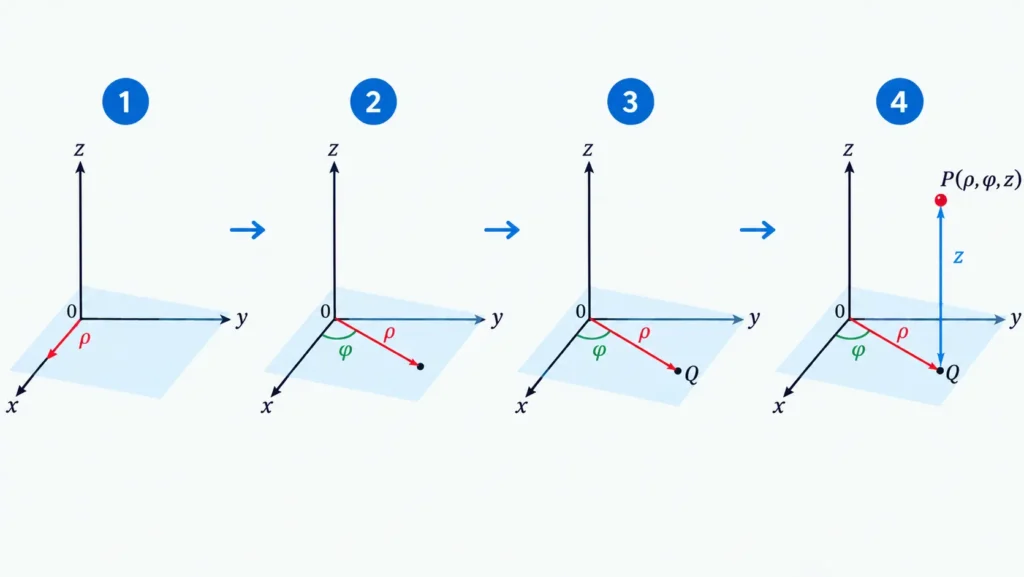
1) Measure the radial distance ρ: Start at the origin and measure the distance ρ straight outward in the xy-plane. For convenience, initially draw it along the positive x-axis.
2) Identify the angle φ: Rotate the radial line anti-clockwise through the specified angle φ, measured from the positive x-axis in the xy-plane.
3) Locate the horizontal position: Use ρ and φ together to mark the point’s projection onto the xy-plane.
4) Move vertically by z: From that projection, move upward if z>0 or downward if z<0 to obtain the final point.
How to Locate a Point Using Cylindrical Coordinates? (Step-by-Step)
To locate the exact position of a point using cylindrical coordinates, we need to know its radial distance (ρ), azimuthal angle (φ), and height (z).
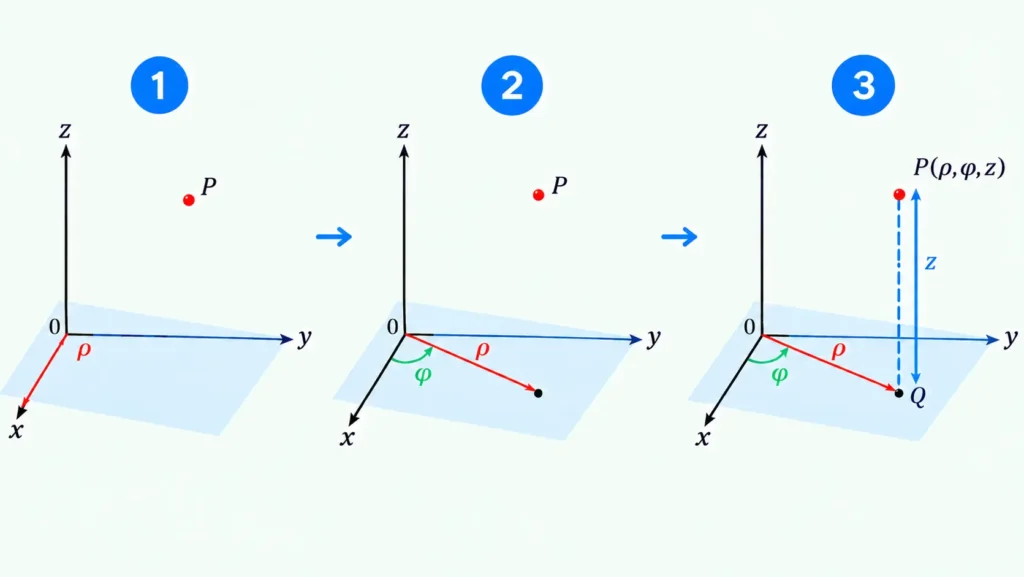
Step 1: Find the Height (z)
Draw a perpendicular projection from the given point onto the xy-plane. The vertical distance between the point and its projection gives the height (z) of the point.
Step 2: Find the Radial Distance (ρ) and Azimuthal Angle (φ)
Draw a straight line from the projection point to the origin. The distance from the origin to the projection point gives the radial distance (ρ). The angle this line makes with the positive x-axis, measured in the xy-plane, is the azimuthal angle (φ).
Step 3: Specify the Position of the Point
Since we know all three coordinates of the point, ρ, φ, and z, we can write its exact position in cylindrical coordinates as (ρ,φ,z).
Cylindrical Coordinates Conversions
If the position of a point is given in a certain coordinate system and you want to convert it into cylindrical coordinates or from cylindrical coordinates into other coordinate types, you can do this with certain formulas that we’re going to discuss in this section.
How to Convert from Rectangular to Cylindrical Coordinates?
In order to convert from cylindrical coordinates (ρ,φ,z) to Cartesian (x,y,z), we use the following three formulas:
To find ρ: ρ = √(x^2 + y^2)
To find φ:
The basic rule is φ = tan-1(y/x). In plain words, the tan of the angle φ equals y divided by x, and the arctangent button on your calculator reverses that. The catch is that this button only answers between -π/2 and π/2 (that is, -90° to 90°). So the points (2, -2) and (-2, 2) both give -π/4, even though they sit on opposite sides of the origin. Arcsine, the angle whose sine is y/ρ, has the same limit, so it will not rescue you either.
The cure is quadrant analysis. Check the signs of x and y first, then adjust the basic result (the value of tan-1(y/x)) as given in the table below:
| Where the Point Sits | Angle φ (Range: (-π,π]) | Angle φ (Range: (0,2π]) |
|---|---|---|
| x > 0, y > 0 (Quadrant I) | tan-1(y/x) | tan-1(y/x) |
| x < 0, y > 0 (Quadrant II) | tan-1(y/x) + π | tan-1(y/x) + π |
| x < 0, y < 0 (Quadrant III) | tan-1(y/x) – π | tan-1(y/x) + π |
| x > 0, y < 0 (Quadrant IV) | tan-1(y/x) | tan-1(y/x) + 2π |
| x > 0, y = 0 (positive x-axis) | tan-1(y/x) = 0 | tan-1(y/x) = 0 |
| x < 0, y = 0 (negative x-axis) | tan-1(y/x) + π = π | tan-1(y/x) + π = π |
| x = 0, y > 0 (positive y-axis) | π/2 | π/2 |
| x = 0, y < 0 (negative y-axis) | -π/2 | 3π/2 |
| x = 0, y = 0 (origin) | Undefined | Undefined |
To find z: The z in cylindrical coordinates is the same as z in Cartesian coordinates, so z = z
Put the values of rectangular coordinates x, y, and z into the formulas, and you’ll get the values of cylindrical coordinates.
Example: Convert rectangular coordinates (-5, 0, -8) to cylindrical coordinates
Solution: Given that x = -5, y=0, z=-8. We need to find cylindrical coordinates ρ, φ, and z.
To find ρ, we have ρ = √(x^2 + y^2)
ρ = √(-5)2 + (0)2
ρ = √ 25 = 5
To find φ, since x<0 and y=0, we have
φ = tan⁻¹(y/x) + π = π
φ = 180
z is the same in both coordinate systems, so z = -8
Hence, Cartesian coordinates (-5,0,-8) in cylindrical coordinates are (5,180°,-8)
How to Convert from Cylindrical Coordinates to Rectangular?
In any Cartesian to cylindrical coordinates conversion, we use the following three formulas:
x = ρcosφ
y = ρsinφ
z = z
Put the values of cylindrical coordinates ρ, φ, and z in the above equations, and you’ll get the values of rectangular coordinates x, y, and z.
Example: Convert cylindrical coordinates (3,45°,5) into rectangular coordinates.
Solution: Given that ρ = 3, φ = 45° and z = 5. We need to find x, y, and z.
Using the conversion formula given above, we have
x = ρ cos φ
= (3) cos 45°
x = 2.12
y = ρ sin φ
= (3) sin 45°
y = 2.12
z = z
z = 5
So the cylindrical coordinates (3, 45°, 5) in rectangular coordinates are (2.12, 2.12, 5).
How to Convert from Spherical to Cylindrical Coordinates?
To convert from spherical coordinates (radial distance r, polar angle θ, azimuthal angle φ) to cylindrical coordinates (radial distance ρ, azimuthal angle φ, height z), we need to know the values of spherical coordinates and then use these three formulas:
To find radial distance ρ: ρ = rsinθ
Where θ is measured from the +z-axis (0° at +z, 90° at the xy-plane, and 180° at -z).
To find the azimuthal angle φ: Since the azimuthal angle φ means the same thing in both coordinate systems, we have φ = φ.
To find height z: z = r cosθ
Where θ is measured from the +z-axis, i.e., θ is zero at the +z-axis, 90° at the xy-plane, and 180° at the -z-axis.
Example: Convert spherical coordinates (5,60°,45°) to cylindrical coordinates (ρ,φ,z).
Solution: Given that r = 5, θ = 60°, and φ = 45°. We can find the cylindrical coordinates radial distance ρ, azimuthal angle φ, and height z using the given formulas:
ρ = rsinθ
= (5) sin60°
ρ = 4.33
φ = φ
φ = 45°
z = r cosθ
= (5) cos 60°
z = 2.5
So, the given spherical coordinates would be (4.33,45°,2.5) after conversion into cylindrical coordinates.
If you want to know how to convert from cylindrical to spherical coordinates, I have discussed it in my topic Spherical Coordinates.
How to Represent a Vector in the Cylindrical Coordinate System?
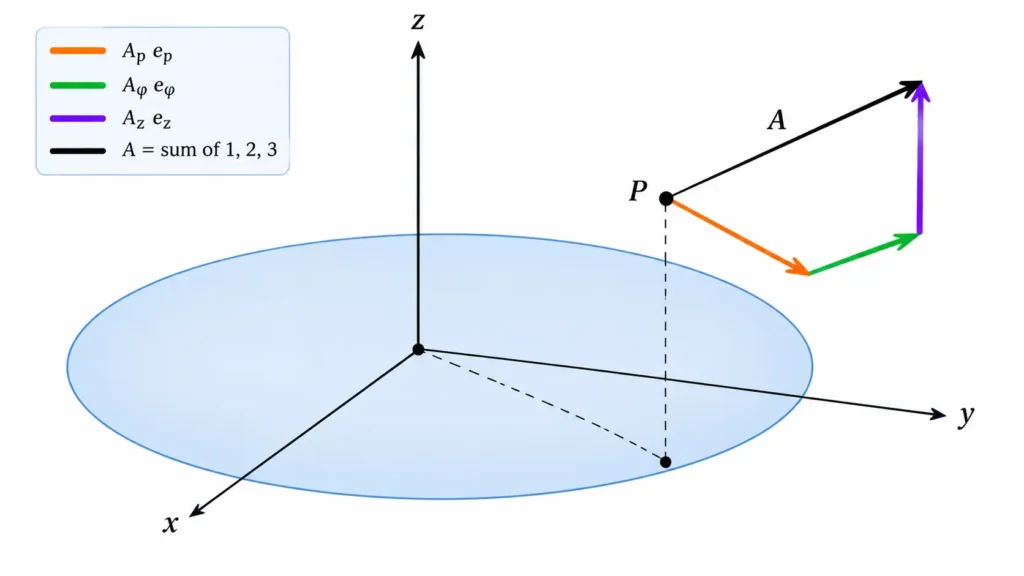
To represent a vector in the cylindrical coordinate system, we use three mutually perpendicular directions and their components. The directions are represented by the unit vectors , , and , respectively.
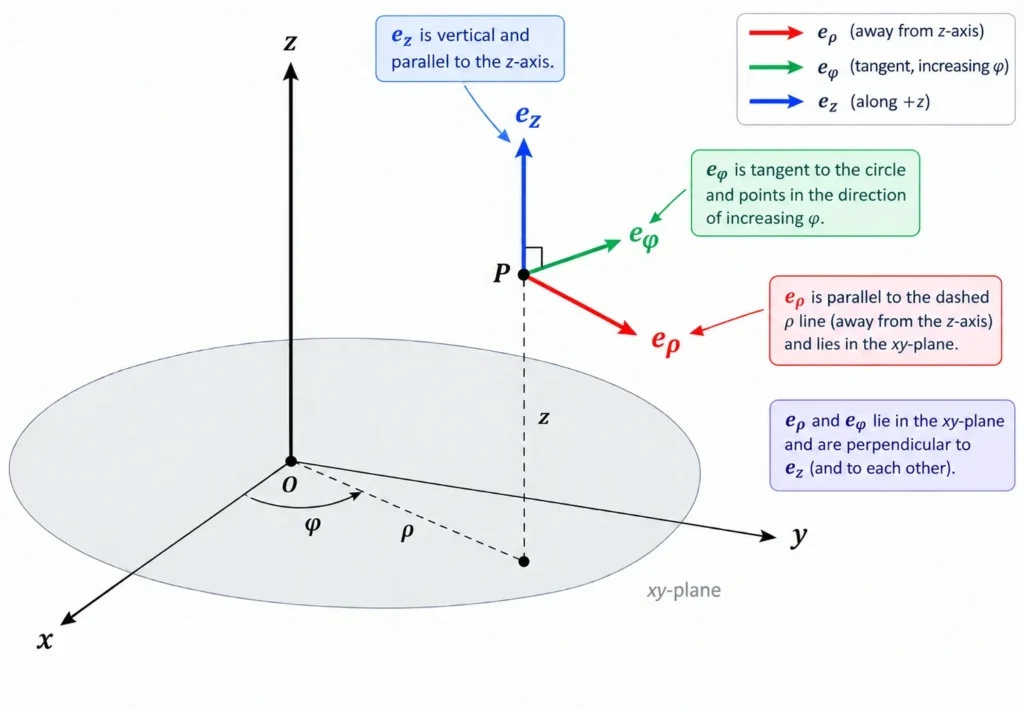
- Radial unit vector (): It points directly away from the z-axis, perpendicular to it, along the line from the axis to the point. It is the direction in which ρ increases. Because it depends on the point’s angle φ, it has no single fixed direction: eρ = cos φ + sin φ .
- Angular unit vector (): It is tangent to the circle of radius ρ around the z-axis, in the direction in which φ increases (counterclockwise when viewed from +z): eφ = -sin φ + cos φ .
- Vertical unit vector (): It points parallel to the z-axis, either upward or downward, depending on the chosen direction.
An important feature of cylindrical coordinates is that the radial and angular unit vectors change their directions as we move around the z-axis, whereas the vertical unit vector remains parallel to the z-axis.
The magnitude of a vector represents its overall length. In cylindrical coordinates, the three mutually perpendicular components combine to form a resultant vector, whose length represents the magnitude of the general vector.
Mathematically, it is calculated using the following formula
|A| = √(Aρ2 + Aφ2 + Az2)
This is Pythagoras’ theorem in three dimensions. For components 3, 4, and 12, the magnitude is 13.
Mathematical Representation
A general vector in cylindrical coordinates can be represented by combining its components along the three unit vectors:
Here, Aρ, Aφ, and Az represent the components of the vector in the radial, angular, and vertical directions, respectively. Each component indicates how much the vector contributes along its corresponding direction.
For example, a vector may have an outward radial component, an angular component around the axis, and an upward vertical component. Together, these components determine the complete vector.
Direction of the General Vector (Geometrical Representation)
To draw a vector, start at the point P and move Aρ along ρ, then Aφ along φ, then Az along z. The arrow from start to finish is the vector.
Cylindrical Coordinates FAQs
1) Are cylindrical and polar coordinates the same?
No. Polar coordinates (ρ, φ) locate points in a plane, while cylindrical coordinates (ρ, φ, z) extend them to 3D by adding a height z.
2) How to read cylindrical coordinates?
Cylindrical coordinates are written as (ρ, φ, z). The first value, ρ, tells you the point’s distance from the z-axis, φ tells you its direction around the z-axis, and z tells you its height above or below the xy-plane.
3) When to use cylindrical coordinates?
Use cylindrical coordinates when a problem has symmetry around an axis, so the quantity depends on distance from the axis (r) and height (z) but not much on angle. Using cylindrical coordinates for objects like cylinders, pipes, wires, cones, and spinning objects makes the problem easier to solve.
Rule of thumb: If x2 + y2 keeps showing up, or the shape is round in the xy-plane but straight along z, switch to cylindrical.

Pingback: Spherical Coordinates | System, Plotting, Conversions, Graphs
Pingback: What is a Coordinate System? Definition and Its Types