
Ever wondered what makes moving objects stop? Why does coffee gradually cool down over time instead of staying hot? Why does a ball thrown in the air always come back down?
These are the kinds of questions that physics tries to answer. The truth is, everything from the tiniest particle in the universe to the largest galaxy follows certain fundamental laws. Physics is about exploring those fundamental laws of nature.
These laws are often expressed in terms of physical quantities.
In this article, we’ll learn the basics of physics that will help us better grasp what the subject is truly about.
What is Physics Definition?
Physics is the scientific study of things that make up our universe, things like matter, energy, space, and time, and their interaction. The objective behind it is to uncover the fundamental laws that tell us how the universe behaves.
I came up with this definition with the help of books, Physics for Scientists and Engineers by Paul Allen Tipler and University Physics by Samuel J. Ling.
As we know, the Big Bang started this universe and created matter, energy, space, and time. Physics studies all these things and how they work together.
By scientific study, we mean that no matter where an idea comes from, it must be tested and confirmed through experiments or observation.
By fundamental, we mean these laws are not derived from any other laws, and they apply universally.
In Physics, a law is a statement that has been proven true repeatedly by various experiments and observations, indicating that it can’t be false in our observed universe.
As our understanding of nature grows over time, some laws are modified, dumped, or become a special case of fundamental laws.
Fundamental Laws of Physics Examples
As the definition says, we study physics to discover the fundamental laws of nature that underlie every phenomenon of nature. In my upcoming articles, I’ll explain each fundamental physics law in detail.
For now, let’s look at some famous laws briefly to give you a clear idea of what physics actually studies.
Law of Conservation of Energy
The law of conservation of energy states that
Energy can transfer between objects or change its type, but in a totally isolated system, the total amount of energy never changes.
This is one of the fundamental rules of nature as it applies everywhere universally and didn’t derive from any other rule.
According to Einstein’s mass–energy equivalence (E = mc²), mass itself is just another form of energy. This means that energy and mass are not separate things, they can change into each other.
So, when we talk about the conservation of energy in modern physics, we also consider mass as a form of energy. Even if some mass disappears (as in nuclear reactions), it reappears as an equal amount of energy. But the total energy remains conserved as mass is also a form of energy.
Without considering the mass-energy relation, the law of conservation of energy won’t hold true.
2nd Law of Thermodynamics
The 2nd law of thermodynamics states that
In an isolated system, disorder or entropy naturally grows or stays the same, but it never reduces on its own. In simple terms, nature always moves toward more randomness, not less.
Rudolf Clausius discovered this fundamental law of nature that applies universally.
Law of Conservation of Momentum
Another fundamental law of nature is the law of conservation of momentum, which says that
In an isolated system, momentum can be shared or exchanged between interacting objects inside the system, but the total momentum stays fixed.
This law is also considered a fundamental law of nature because it can be applied universally anywhere and is not derived from any other law.
What are the Main Branches of Physics?
Physics is a broad field where there are various branches of physics, some interdisciplinary and some that focus on specific areas of nature.
As our understanding of the universe increases, new branches also emerge. Here are some of the main branches of physics
1. Mechanics
Mechanics is a branch of physics that studies how and why things move, as well as the various ways to describe their motion.
It has several forms, each used for different situations:
Classical Mechanics
Classical mechanics studies the motion of large, visible objects that move much slower than the speed of light or far from places with strong gravity.
The earliest formulation of classical mechanics is known as Newtonian mechanics. It describes the motion of objects under the influence of external forces. It includes famous laws like Newton’s laws of motion and the universal law of gravitation.
Later, in classical mechanics, new forms came about, such as Lagrangian and Hamiltonian mechanics. They describe motion using energy instead of force.
In classical mechanics, if the present state of an object is known, we can know the past and future states of the object by using its laws.
Quantum Mechanics
Quantum mechanics is the branch of mechanics that describes the motion of objects at the microscopic level, like the motion of atoms, nuclei, electrons, and other tiny particles.
For small objects, typically of size 10-9meters or smaller, the objects don’t behave like classical mechanics predicts. This is where Quantum mechanics becomes necessary.
Relativistic Mechanics
Relativistic mechanics studies the motion of objects with speeds near the speed of light or that are near strong gravity, like near a black hole.
The object with this speed or near a strong gravity follows the rules given by Einstein’s theory of special and general relativity, as classical mechanics failed to give accurate results in this realm.
2. Thermodynamics
Thermodynamics is a part of physics that explains how heat energy changes into other forms of energy and how heat, temperature, and work are connected.
When thermodynamics began as a new branch, scientists were mainly interested in steam engines and other machines that used heat energy.
They wanted to understand how heat energy could be converted into mechanical motion or work efficiently.
Hence, the name coined as thermodynamics:
- Thermo meaning heat
- Dynamics means force (that causes some mechanical work)
3. Acoustics (Sound)
Acoustics is the branch of physics that studies sound. It studies how the sound is produced, how it travels through different media, and its different properties.
Sound is a kind of energy that is made when something vibrates (moves back and forth very fast). These vibrations travel through the air, water, or other materials as sound waves. When these waves reach our ears, our brain understands them as different sounds.
There are lots of fields where the concepts of acoustics are used, like in Architecture and building design to sound clear and evenly distributed, in the medical field for imaging inside the human body, and in many other fields as well.
4. Optics
Optics is the type of physics that studies light (in broad terms electromagnetic radiation), including its behavior, properties, and interactions with matter.
Originally, optics focused on human vision and the functioning of the eye. As lenses and other devices were developed to aid vision, these became known as optical instruments, and instruments that detect or manipulate light became part of the field.
By the 20th century, optical methods were applied to parts of the electromagnetic spectrum beyond visible light, including ultraviolet, infrared, X-rays, and microwaves.
Today, optics encompasses the study and application of light across a broad range of the electromagnetic spectrum, not just visible light.
5. Electromagnetism
Electromagnetism is the branch of physics that studies electricity, magnetism, and the interactions between them.
The core concept of electromagnetism is studying the relation between the electric field and magnetic field and how they influence each other. A changing electric field produces a magnetic field, and a changing magnetic field produces a current.
6. Atomic Physics
Atomic physics is a type of physics that studies the structure of an atom as a whole (nucleus and its surrounding electrons) and how it interacts with photons, electrons, or other atoms and changing its energy states and arrangements.
It generally considers the atoms in isolation. It doesn’t discuss the formation of molecules nor does it explain the behavior of atoms in the solid state.
So, atomic physics studies what happens when a photon hits the isolated atom, an electron interacts with the atom, or another atom interacts with the atom temporarily.
7. Nuclear Physics
It is the branch of physics that studies what is inside the atomic nucleus, like what kind of particles a nucleus is made of, how these particles interact, and the forces and reactions that occur within it.
Nuclear physics is at the heart of many fields, such as nuclear energy, medical diagnostics and treatment, dating ancient artifacts, food preservation, space missions, and industrial applications.
8. Particle Physics
Particle physics studies the fundamental subatomic particles and fundamental forces of nature that make up the whole matter and radiation in the universe. It also studies how these fundamental particles combine to form protons, neutrons, and other composite particles.
Fundamental particles are indivisible, meaning they cannot be broken down into smaller parts, and by fundamental forces, we mean the forces are not reducible to simpler forces.
There are 4 types of fundamental forces or interactions, i.e., gravitational, electromagnetic, strong, and weak nuclear forces.
According to the Standard Model, fundamental particles are 61. These include 48 fermions, which are the building blocks of matter, and 13 bosons, which are responsible for carrying the forces between particles.
9. Plasma Physics
It is a branch of physics that studies plasma, which is known as the 4th state of matter or ionic state of matter.
When a solid is heated, it turns into a liquid. Heating the liquid further turns it into a gas. If we keep heating the gas to extremely high temperatures, the atoms lose their electrons and the gas becomes ionized. This ionized gas is what we call plasma.
So, in plasma physics, we understand how matter behaves and what properties it has, when it is so hot that the atoms of it can’t exist in its neutral state, and one or more electrons become free from atoms.
10. Condensed Matter Physics
Condensed matter physics is the branch of physics that studies the properties of matter, in its solid and liquid states, that exist due to the electromagnetic forces between atoms and electrons.
For example, it explains why metals like copper conduct electricity, why silicon is used in computer chips, why iron sticks to magnets, and how some materials can become superconductors with zero resistance. It also covers everyday things like how LCD screens work using liquid crystals.
11. Cosmology
Cosmology is a type of physics that studies the universe as a whole, i.e., it answers the questions that are asked about the universe as a whole.
For example, how the universe came into being, how it is expanding with the passage of time or what the universe as a whole is made of, etc.
12. Environmental Physics
Environmental physics is a branch of physics that applies the laws of physics to understand the processes happening in our environment and how these processes affect living things.
It explains things like how the greenhouse effect warms the Earth, how solar panels convert sunlight into usable energy, or how pollutants spread in the air and water.
13. Computational Physics
Computational physics is a branch of physics that uses computers to study and solve physics problems that are too hard to do with math alone or too difficult to test in real life.
It uses computer simulations and numerical methods to study complex physical systems, such as weather, galaxies, nuclear reactions, and quantum particles.
In short, computational physics involves physics, computers, and mathematics to study nature.
It uses computer simulations and numerical methods to study complex physical systems, such as weather, galaxies, nuclear reactions, and quantum particles.
What are Physics Examples in Real Life?
Physics is part of everyday life, from walking and riding a bicycle to cooking food and using a smartphone. For example, friction helps your shoes grip the ground, gravity makes a dropped ball fall, and heat transfers from a hot stove to a cooking pot. Mirrors reflect light so you can see yourself.
There are tons of other examples in everyday life where physics concepts are applied. We’ll discuss some of them here
1. Physics Behind Riding a Bicycle
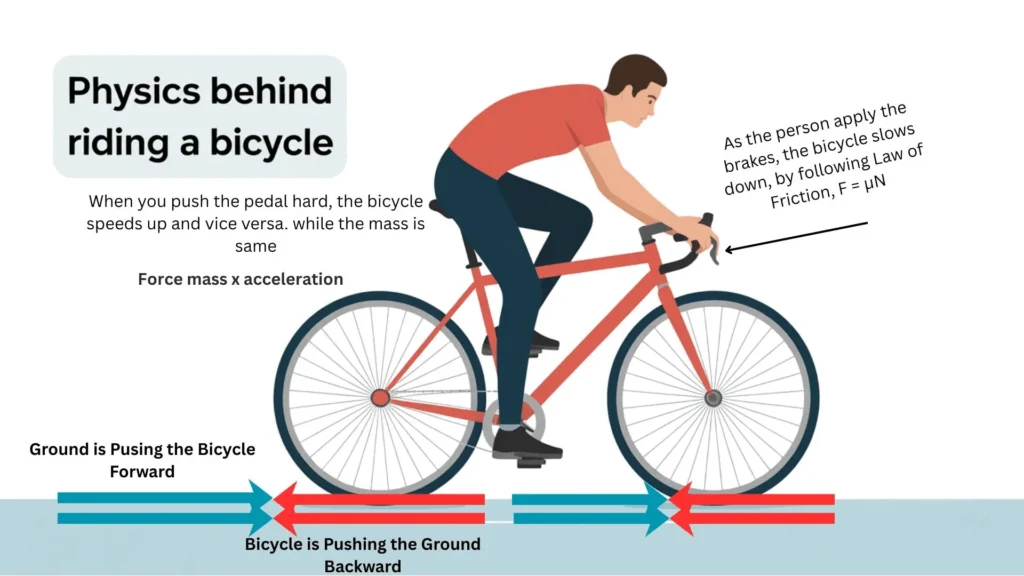
When you push the pedals, the bicycle speeds up. This is explained by Newton’s Second Law of Motion (Force = mass × acceleration). According to this law, as the force increases, the acceleration also increases while the mass is the same.
Now, if you look closely, as the wheel moves, it applies a force on the ground backward at the point of contact. According to Newton’s Third Law, for every force there is an opposite force which is equal in magnitude and acts simultaneously in the opposite direction.
As the wheel of a bicycle pushes backward on the ground, the ground pushes the wheel forward with an equal and opposite force. This forward push from the ground makes the bicycle move ahead.
The brakes slow down the bicycle because of friction. The Law of Friction (F = μN) says the harder two surfaces press together, the more friction they make. Where F is the frictional force, μ is the coefficient of friction whose value depends on the materials of the surfaces in contact, and N is the normal force applied.
2. Physics of Human Voice
To produce voice, we first need air as the energy source. Our lungs act like an air pump. When you exhale, air is pushed upward through the trachea.
Inside the throat, just above the trachea, lies the larynx (commonly called the voice box). It contains vocal folds (or vocal cords), two small, flexible bands of muscle.
When you decide to speak, your brain sends signals to muscles in the larynx, causing the vocal cords to move closer together.
Now, airflow from the lungs interacts with these cords. This is where physics really comes into play.
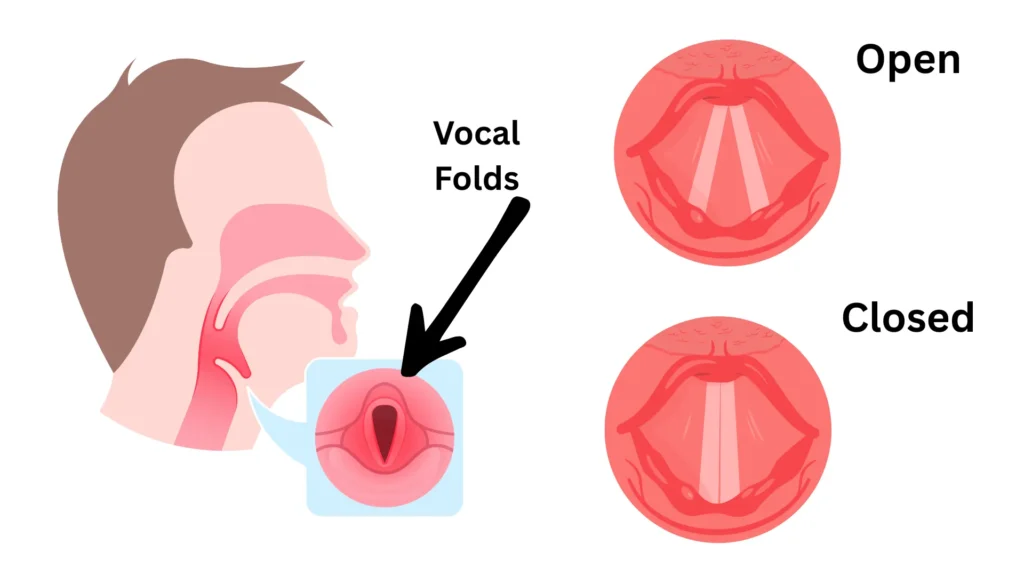
As the vocal cords are closed, the air pressure starts building up below the vocal cords (known as the subglottal pressure). Once this pressure is strong enough, it pushes the vocal cords slightly apart.
A small puff of air rushes through the opening.
At this point, Bernoulli’s Principle comes into play. It says that when air moves faster through a narrow space, its pressure becomes lower than the air around it. This pressure difference pulls the cords back together.
So, two forces are always competing:
- Air pressure from below pushes the cords apart.
- Pressure difference from Bernoulli’s effect pulls them together.
This push-and-pull cycle causes the cords to open and close rapidly, creating vibrations.
The rapid opening and closing of the cords generate periodic vibrations in the air. These vibrations are the source of the sound wave.
If the vibration frequency is within the audible range (20 Hz–20 kHz), we perceive it as sound.
The raw sound made by the vocal folds is actually quite weak and buzzy. To make it louder, clearer, and more pleasant, our body uses spaces called resonating chambers.
These are the hollow spaces like the throat, mouth, and nose where sound waves bounce around, get amplified, and change in quality. The tongue, lips, and teeth further shape the sound into specific words.
3. Physics Behind Rainbow Formation
A rainbow in the sky forms when sunlight is dispersed after interaction with countless tiny water droplets that seem suspended in the air after rainfall.

Sunlight looks white, but it’s actually made up of many colors. When light moves from one material to another, like from air into water, it bends.
According to Snell’s law (the law of refraction), how much the light bends depends on its wavelength and how dense the new material is.
When sunlight enters a spherical water droplet, three things happen that help in rainbow formation:
- Refraction at entry: The light bends towards the normal as it enters the water droplet. Since each color has a slightly different wavelength, each color bends by a different amount. This separation of white light into its colors is called dispersion.
- Reflection inside the droplet: This dispersed light, some part of it is reflected from the inner wall of the droplet and sends it to your eyes, due to which you are able to see the rainbow. That’s why it is suggested that if you want to see the rainbow, you should look in the opposite direction from the sun.
- Refraction at exit: As the light exits from water back into air, it bends away from the normal again.
The overall effect is that the rays entering the droplet emerge at various angles, from nearly 0° up to about 42°, the angle between the incoming sunlight and the exit sunlight. The light becomes most intense around 42° because this is a special turning point.
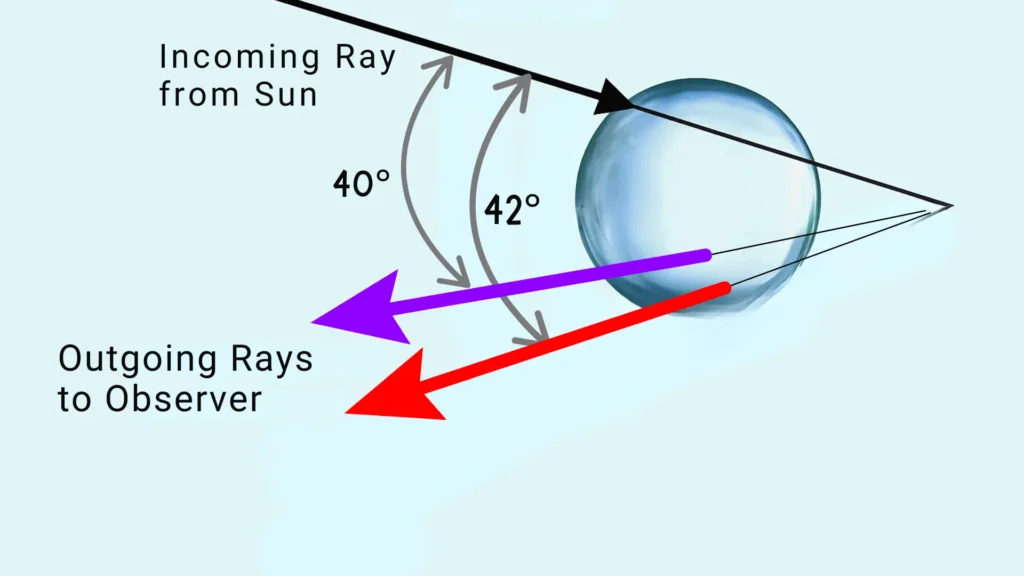
At this point, the angle of deviation (the amount the light is bent overall) stops increasing and begins to decrease. As a result, many rays that enter the droplet at slightly different points all end up leaving in almost the same direction. While for other directions, nothing like this happens.
This overlap, or clustering of rays around 42°, causes a concentration of light that appears as a bright region in the sky. When millions of droplets do this together, their combined light forms the bright, colorful arc we recognize as a rainbow.
If you want to learn more about how physics is used in everyday life, you can read a book called The Flying Circus of Physics by the famous physicist Jearl Walker. It explains many phenomena of nature where physics is applicable.
Is Physics Hard?
Yes, Physics is considered hard because it talks about many things we can’t see with our naked eyes, like atoms, electrons, nuclei, quarks, etc. The mathematics behind the laws and theories of physics can also be complex.
The logic behind the things that physics explains could be difficult to understand.
But with a good physics teacher, it becomes much easier to grasp, because physics is all about understanding, not memorizing. And as Richard Feynman said, the best way to learn is to teach, explaining physics to others helps you understand it more deeply.

Pingback: Spherical Coordinates | System, Plotting, Conversions, Graphs
Pingback: Cylindrical Coordinates | System, Plotting, and Conversions