
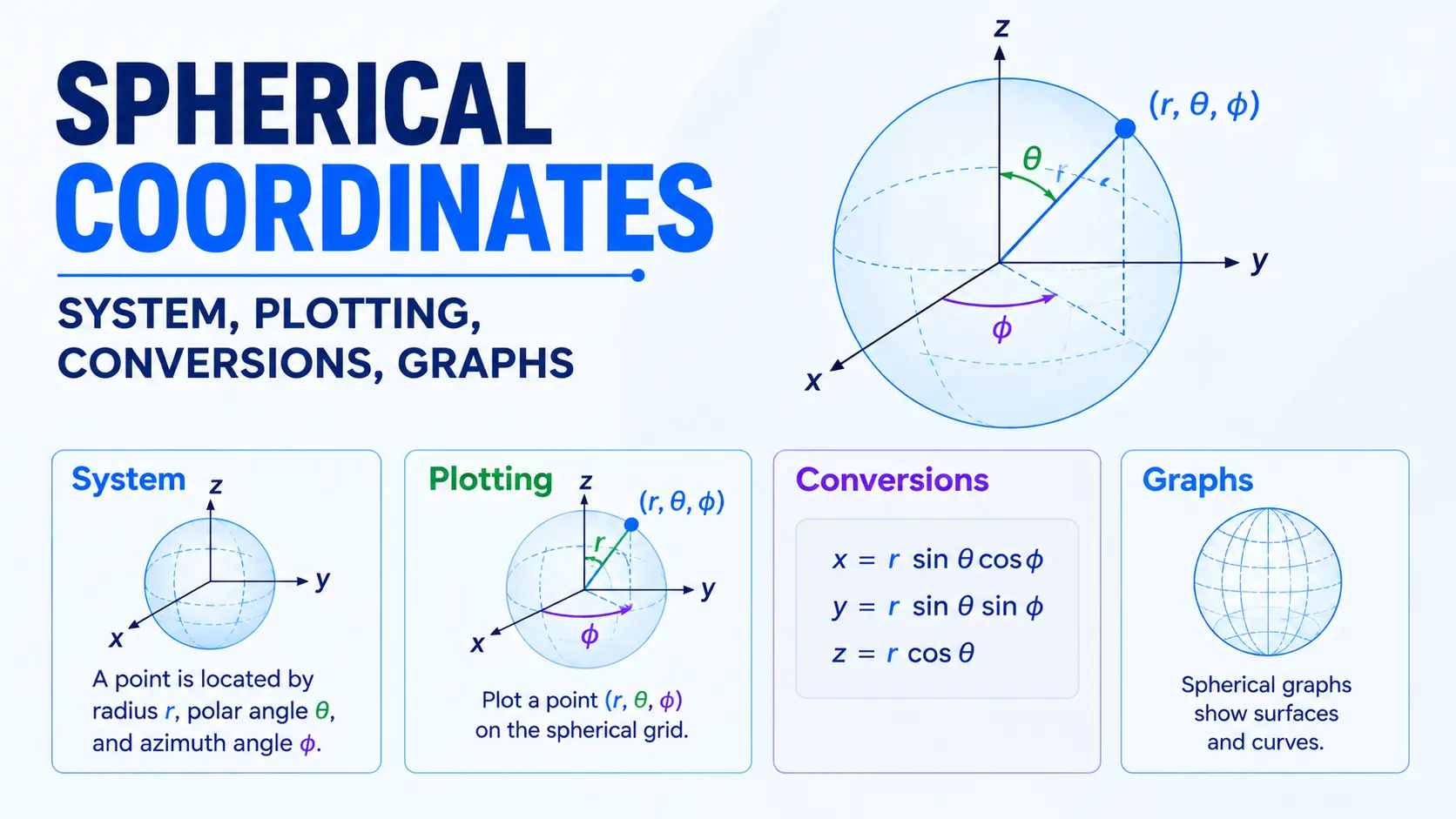
Spherical coordinates are three numbers used to specify the exact position of a point in three-dimensional space within a spherical coordinate system. In this system, the numbers are one radial distance and two angles.
Loosely, spherical coordinates can refer to both the spherical coordinate system and the three coordinate values. The context determines the intended meaning of the term. It is the extended version of the two-dimensional polar coordinate system.
In this article, we’ll explore what a spherical coordinate system is and what spherical coordinates are. You’ll also learn how to plot points using spherical coordinates, convert between spherical, cylindrical, and Cartesian coordinates, and graph equations in the spherical coordinate system.
What is a Spherical Coordinate System?
A spherical coordinate system is a three-dimensional coordinate system that uses three numbers (a radial distance and two angles) to specify the exact position of a point.
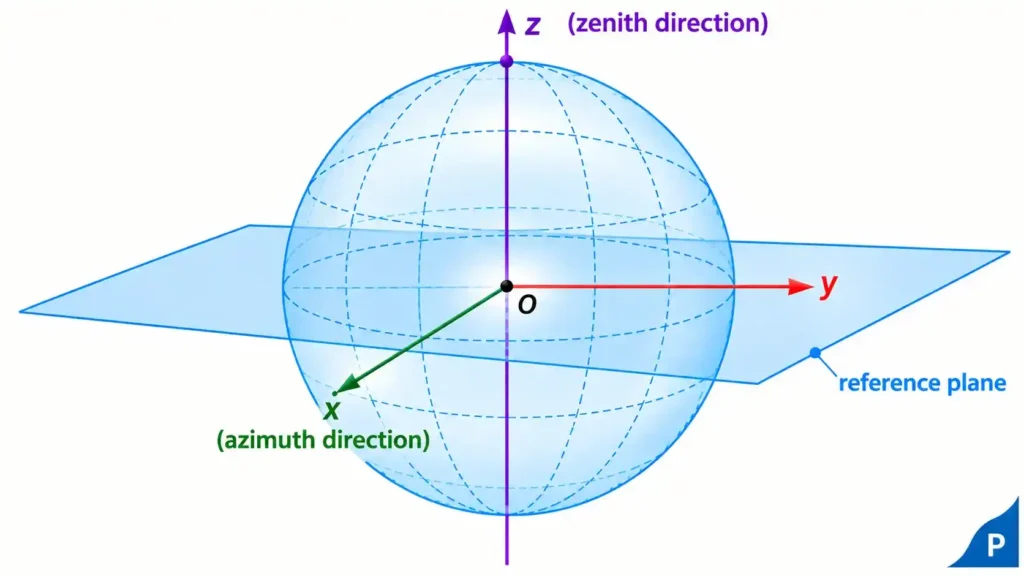
The system consists of the origin, a polar axis along the zenith direction, a reference plane, and an azimuth direction. With the help of these, we define three spherical coordinates: radial distance r or ρ (rho), polar angle θ (theta), and azimuthal angle ϕ (phi), which describe a point’s exact position in space.
You can use the spherical coordinate visualizer below to visualize the plotting of the exact position of a point using spherical coordinates and learn how it all works together in the spherical coordinate system.
Let me explain each element briefly
Origin: It is a fixed point we take as a reference to locate our target points in space. It is marked at a radial distance of zero and is conventionally written as (0,0,0).
Important Note: At the origin, the angles technically have no unique direction, because when ρ=0, the point is at the origin regardless of the values of θ and ϕ. So (0,0,0) is just a conventional representation. In general, at ρ=0, no matter what the angle is, you stay at the origin.
Polar axis or Zenith direction: It is a fixed vertical line we draw from the origin along the positive z-axis to measure the tilt of the given point from it. The measure of tilt is known as the polar angle. The direction pointing straight up along the polar axis is called the zenith direction.
Reference plane: It is a plane or two-dimensional surface that passes through the origin and is perpendicular to the polar axis. We measure the azimuth angle in this reference plane.
Azimuth direction: The direction along the +x-axis or +y-axis from the origin can be represented as the azimuth direction. Generally, we take it along the +x-axis. By taking this direction as a reference, we measure the azimuthal angle.
Spherical Coordinates
Spherical coordinates are three numbers that we use to locate the exact position of a point in 3D space. They are also known as spherical polar coordinates. They are
Radial distance: This is the straight-line distance from the origin to the given point. This straight line is called the radial line.
- This is the same radial coordinate as in polar/cylindrical coordinates
- It tells you how far the point in space is from the origin.
- Radial distance is usually represented by r in physics and often by ρ (rho) in mathematics, although notation can vary.
- The value of r is never negative. It may be zero or any positive number, i.e., r ≥ 0.
Polar Angle: This is the angle between the radial line connecting the origin to the given point and the polar axis.
- Other common names for polar angle are zenith angle, Inclined angle, or normal angle.
- In physics, we represent it with the symbol θ (theta). In mathematics, it is represented as ɸ (phi).
- It tells you how far the point is from the vertical axis (+z-axis or polar axis).
- At any polar angle θ, if you rotate around the z-axis, you form a circle. All the points on that circle have the same polar angle θ.
- It ranges from 0 to 𝝅 or 0 to 180°, i.e., 0 ≤ θ ≤ 180°.
Azimuthal Angle: This angle describes the rotation of a point around the z-axis, measured in the xy-plane starting from the positive x-axis to the point’s projection onto that plane.
As mentioned earlier, keeping the polar angle θ fixed forms a circle on which all the points have the same polar angle θ. To specify where on that circle, we measure the azimuthal angle in the horizontal reference plane from the +x-axis to the point’s horizontal projection.
- In physics, we represent it as ɸ (phi), and in mathematics, it is represented by θ (theta).
- It tells you how much to rotate around the z-axis from the +x-axis to reach the given point.
- It ranges from 0 to 2𝝅 or 0 to 360°, i.e., 0 ≤ ɸ < 360°.
The polar angle ranges from 0° to 180°, not 0° to 360°, because, at a fixed radius, the azimuthal angle sweeps a full circle at each polar angle around the +z-axis. Extending the polar angle to 360° would repeat points already covered.
To understand it better, imagine a globe:
As the polar angle increases from 0° to 180°, its position shifts from the North Pole, passes the equator at 90°, and reaches the South Pole. At every stop, the azimuthal angle lets you travel all the way around that latitude.
Together, polar angles from 0° to 180° and a full 360° azimuthal rotation cover the entire surface of the globe.
The spherical coordinates are written in a specific order within parentheses known as the ordered triple or 3-tuple. In physics, this specific order is (radial distance, polar angle, Azimuthal angle), i.e., (r,θ,ɸ). In mathematics, the order is (Radial distance, Azimuthal Angle, and Polar Angle), i.e., (r,θ,ɸ).
Note: For this article, we’re taking the convention used in physics. You need to use the convention that is mentioned in your textbook.
How to Plot a Point Using Spherical Coordinates? (Step-by-Step)
To plot a point using spherical coordinates in the spherical coordinate system, follow this step-by-step procedure:
1. Draw a spherical coordinate system
To get the spherical coordinate system, draw the origin O and two perpendicular directions, usually along the +x-axis and +z-axis. The direction along the +x-axis is called the azimuth direction, and the direction along the +z-axis is known as the zenith direction. This setting defines the reference plane that passes through the origin and is perpendicular to the zenith direction (+z-axis).
2. Identify the spherical coordinate values
Identify the given values of spherical coordinates (r,θ,ɸ). For example, the spherical coordinates are (4, 60°, 45°).
3. Draw a straight line of distance r from the origin towards the azimuth and zenith directions that is equal to 4 for our current example.
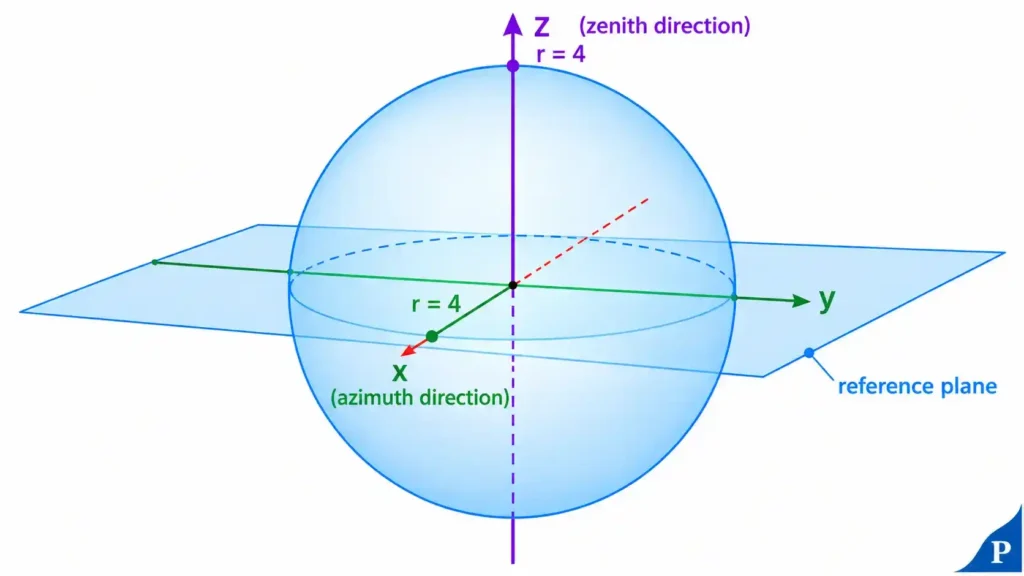
4. From the +x-axis (azimuth direction), rotate the radial line r = 4 to 60° (azimuthal angle ɸ) anti-clockwise in the reference plane towards the +y-axis. When viewed from the positive z-axis, the azimuthal angle rotates counterclockwise.
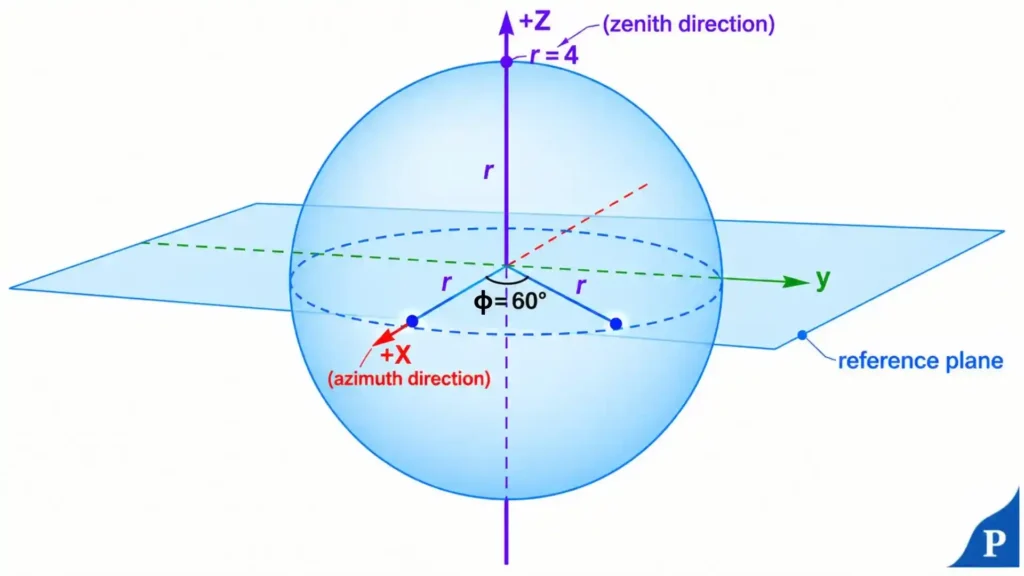
5. Draw an arc centered at the origin, starting from the point on the +z-axis at (r=4). The arc should pass through the point defined by the azimuthal angle (ɸ = 60°) and continue downward toward the -z-axis.
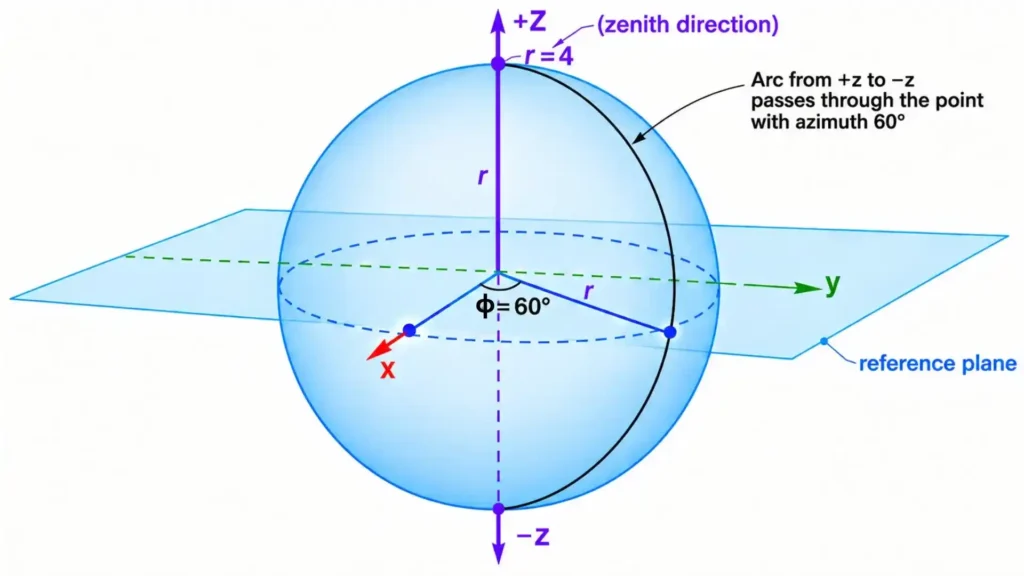
6. Now, rotate the radial line away from the zenith direction towards the xy-plane (reference plane) along this curve by θ = 45°, as given in our example.
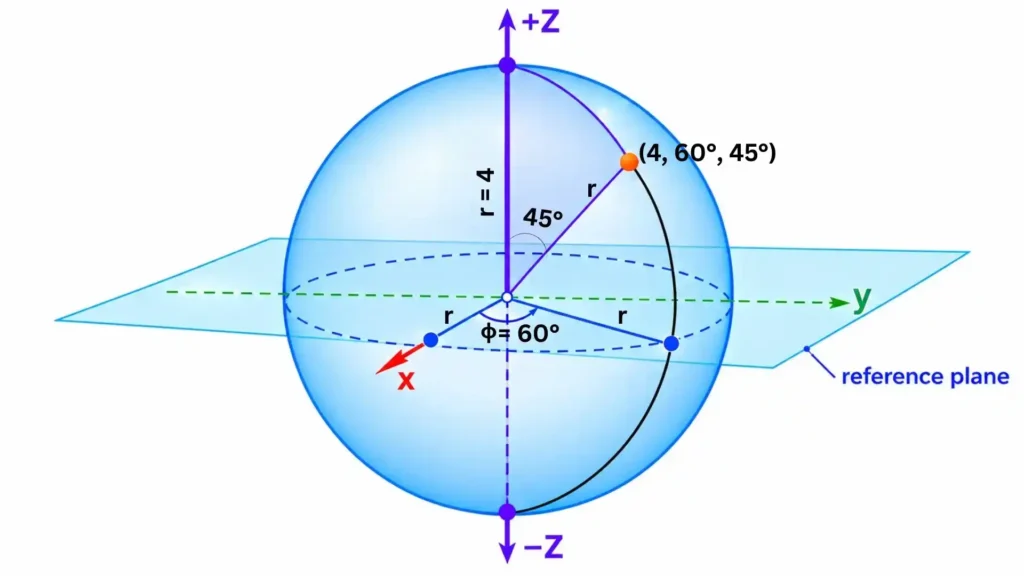
7. This gives us the final point (4,60°,45°) plotted in the spherical coordinate system.
How to Locate a Point Using Spherical Coordinates? (Step-by-Step)
If you are given a point in space and asked to determine its spherical coordinates, follow this step-by-step procedure:
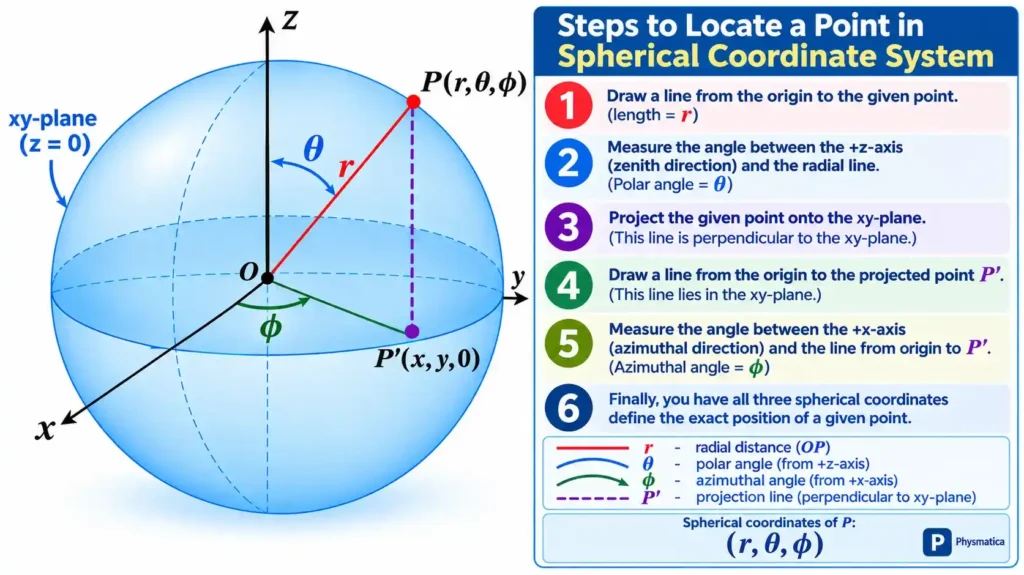
1) Draw a straight line from the origin to the given point. This is called the radial line, and the magnitude of this line gives the radial coordinate r.
2) Find the angle between the radial line and the positive z-axis (polar axis). This gives the polar angle θ.
3) Draw a perpendicular projection from the given point to the reference plane (xy-plane). The point where the projection meets the xy-plane is the given point’s projection onto the reference plane.
4) Draw a straight line from the origin to the projection point on the xy-plane.
5) Measure the angle between the projection line and the +x-axis. This gives the azimuthal angle ɸ.
6) Finally, you have determined the three spherical coordinates: radial distance (r), polar angle (θ), and azimuthal angle (ɸ).
How to Convert Spherical Coordinates to Cartesian?
To convert spherical coordinates (radius r, polar angle θ, azimuthal angle ɸ) to Cartesian (x,y,z), we use three spherical-to-Cartesian conversion formulas, which are as follows:
x = r × sinθ × cosɸ
y = r × sinθ × sinɸ
z = r × cosθ
The value of the radial coordinate r ranges from 0 to infinity, i.e., [0,∞). The azimuthal angle ɸ ranges from [0,2π), and the polar angle θ ranges from [0,π]. If you have the values of spherical coordinates, by putting them into these formulas, you get the values of Cartesian coordinates. For example, the spherical coordinates are (4,60°,45°), where r = 4, θ = 60°, and ɸ = 45°. Using spherical-to-Cartesian conversion formulas, we have,
x = 4 × sin45° × cos60°
= 4 × (1/√2) × (1/2)
x = 1.41
y = 4 × sin45° × sin60°
= 4 × (1/√2) × (√3/2)
y = 2.45
z = 4 × cos 45°
= 4 x (1/√2)
z = 2.83
The spherical coordinates (4, 60°, 45°), after conversion, become Cartesian coordinates (1.41, 2.45, 2.83). If you want to learn how to plot a point in a Cartesian coordinate system. I have explained it in detail in my article, Cartesian coordinate system.
How to Convert Cartesian Coordinates to Spherical?
You can convert Cartesian coordinates, also known as rectangular coordinates, into spherical coordinates using the following conversion formulas:
1) r = √x2+y2+z2
2) θ = arccos (z/r) = cos-1(z/r) = arccos(z/√(x2+y2+z2))
We can also write this conversion formula using the arctangent function, i.e.,
θ = arctangent (√(x2+y2) / z)
The standard output range of arctan is from -π/2 to π/2. However, the range of the polar angle θ is 0 to π. So, we need to correct the value of the angle when θ is negative. Based on this, we have some conditions under which this formula changes
| Conditions | θ Formula |
|---|---|
| If z > 0 | θ = arctangent (√x2+y2 / z) |
| If z < 0 | θ = π + arctangent (√x2+y2 / z) |
| If z = 0 and √(x^2 + y^2) ≠ 0 | π/2 |
| If x = y = z = 0 | Undefined |
3) ɸ = sgn (y) arccos (x/√x^2 + y^2)
Where sgn (y) means the sign (+/-) of the y coordinate.
If we write this formula in terms of arctan, in general form it would be
ɸ = arctan(y/x)
The arctangent formula may produce an incorrect azimuthal angle when x and y have different signs. Consider the points (1,1) and (-1,-1). Applying the same arctangent formula to both points gives the following values for ɸ:
For (1,1)
ɸ = arctan (1/1) = 45°
For (-1,-1)
ɸ = arctan (-1/-1) = arctan (1) = 45°
But we all know that the point (-1,-1) lies in the third quadrant, and its angle must be between 180° and 270°. That’s why we need to modify the formula expressed in arctan, as mentioned in the following table
| Conditions | ɸ Formula (when ɸ = [0,2π)) | ɸ Formula (when ɸ = (-π,π]) |
|---|---|---|
| x > 0 and y ≥ 0 | ɸ = arctan(y/x) | arctan(y/x) |
| x > 0 and y < 0 | arctan(y/x) + 2π | arctan(y/x) |
| x < 0 and y ≥ 0 | arctan(y/x) + π | arctan(y/x) + π |
| x < 0 and y < 0 | ɸ = arctan(y/x) + π | arctan(y/x) – π |
| x = 0 and y > 0 | π/2 | π/2 |
| x = 0 and y < 0 | 3π/2 | -π/2 |
| x = y = 0 | Undefined | Undefined |
How to Convert from Cylindrical to Spherical Coordinates?
In order to convert cylindrical coordinates (axial radius ρ, azimuth ɸ, elevation z) into spherical coordinates (radius r, polar angle θ, azimuthal angle ɸ), we use the following formulas:
To find r: r = √ρ2 + z2
To find θ: θ = arccos (z / √ρ2 + z2) = arctan (ρ / z)
If we’re using the arctan function to find the value of θ, certain conditions apply, as arctan returns values from π/2 to -π/2 and θ varies from 0 to π. For the values where arctan gives a negative angle, we need to convert it so that it lies in the range of 0 to π.
The conditions are mentioned in the following table
| Conditions | Formula with arctan |
|---|---|
| z > 0 | arctan (ρ / z) |
| z=0 and ρ>0 | π/2 |
| z < 0 | arctan (ρ / z) + π |
To find ɸ: Since this coordinate means the same thing in both spherical and cylindrical coordinates, ɸ = ɸ.
How to Graph a Spherical Coordinate Equation?
To graph a spherical coordinate equation, choose values for the independent coordinates and solve the equation to get the remaining coordinate. Next, plot these points (r, θ, ɸ) in the spherical coordinate system. Sketch the curve or surface through these points that satisfies the equation.
Example: Draw the graph of the spherical coordinate equation r=4 cosθ.
To graph r = 4 cosθ, we’ll choose different values of the independent coordinate θ and find the value of r for them. One important thing to note is that since r ≥ 0, to keep r greater than zero, we need to restrict θ from 0° to 90°. Since ɸ does not appear in the equation, it can take any value from 0° to 360° for each (r,θ).
First, keep ɸ = 0, take different values of θ, and find r as shown in the table
| θ | r = 4cosθ |
|---|---|
| 0° | 4 |
| 30° | |
| 45° | |
| 60° | 2 |
| 90° | 0 |
After plotting these points in the spherical coordinate system, we get the graph shown in the image below.
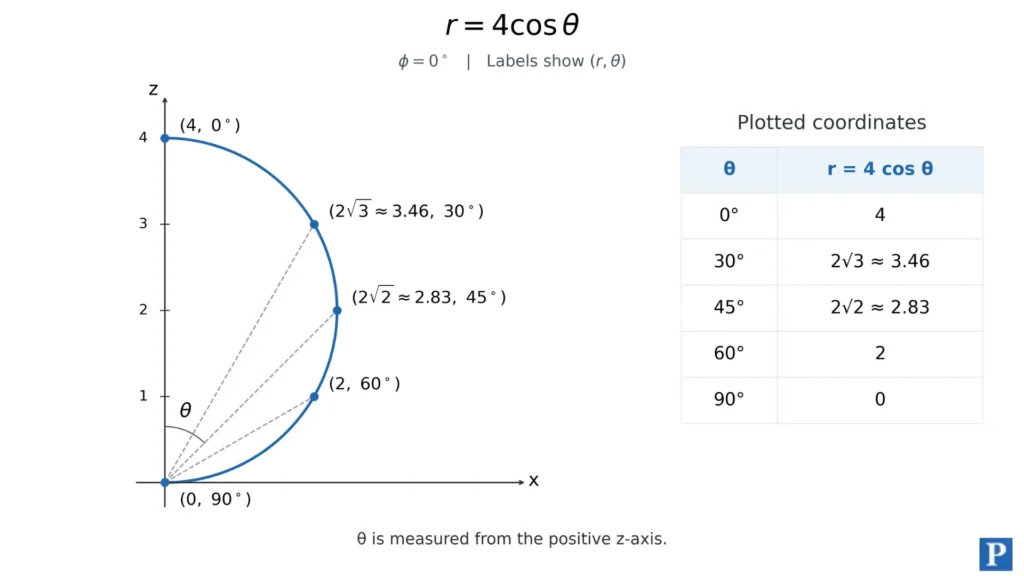
Since ɸ can take any value from 0° to 360°, each point on the semicircle rotates around the z-axis. Together, these rotations generate the sphere shown below.
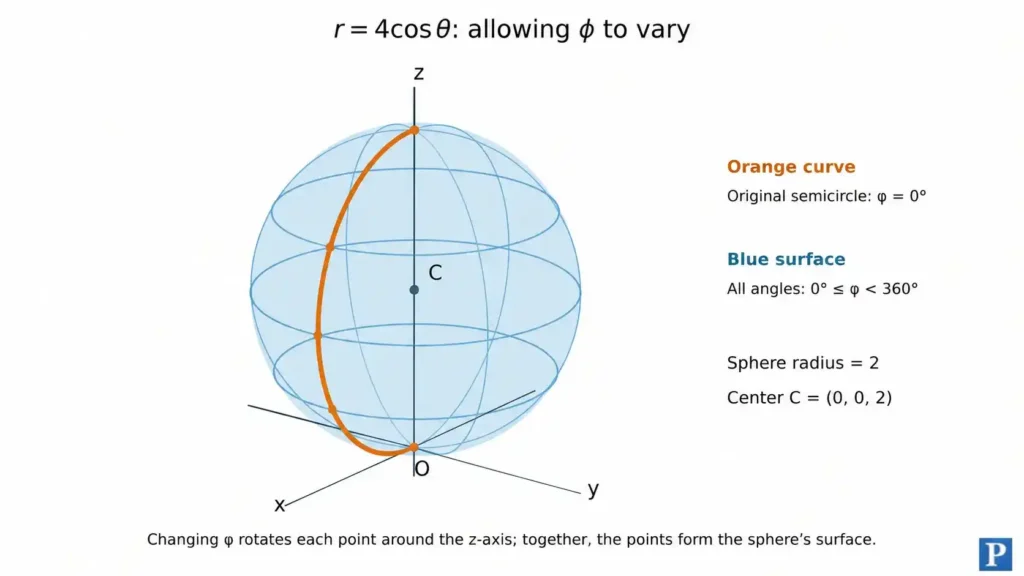
This is the final graph of the spherical coordinate equation r = 4 cosθ.
How to Represent a Vector in the Spherical Coordinate System?
To represent a vector at a particular point in spherical coordinates, we use three mutually perpendicular unit vectors: the radial unit vector , the polar angle unit vector , and the azimuthal unit vector .
When combined with their respective scalar components, they represent the magnitude and direction of the general vector.
Mathematical Representation
Mathematically, a general vector can be written as
A = Ar + Aθ + Aɸ
Where
- Ar tells us how much the vector A points in the radial direction .
- Aθ tells us how much the vector A points in the polar direction .
- Aɸ tells us how much the vector A points in the azimuthal direction .
Magnitude of the General Vector
The magnitude of vector A is calculated using the formula
A = √(Ar2 + Aθ2 + Aɸ2)
Directions of the Unit Vectors
The direction of the unit vector is taken along the increasing radial distance from the origin. Since rotating the polar angle generates a curve. At a particular point, the direction of the unit vector is tangent to that curve in the direction of increasing θ.
Similarly, the direction of the unit vector at a particular point is tangent to the curve (made by moving ɸ) in the direction of increasing ɸ.
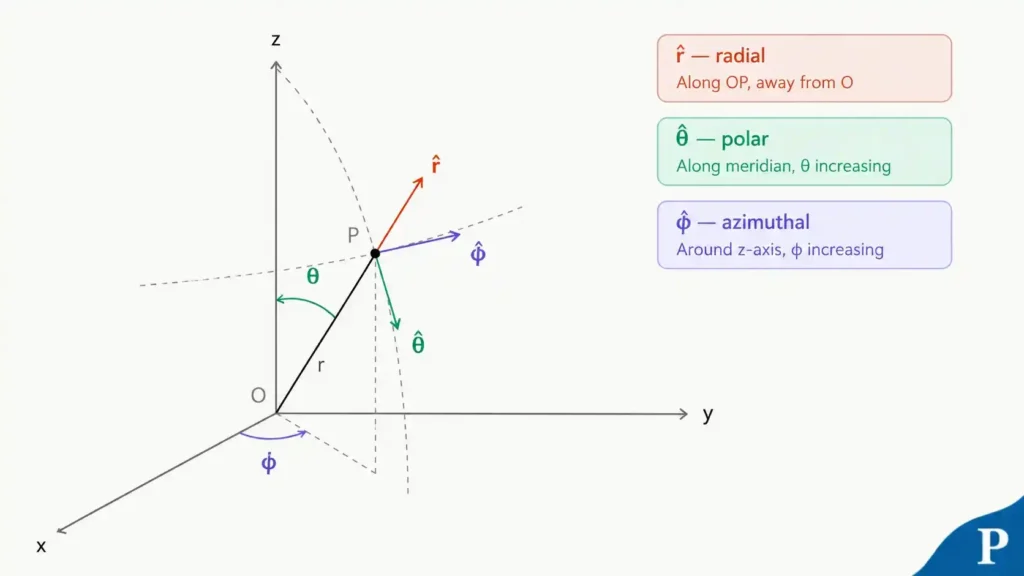
Direction of the General Vector (Geometrical Representation)
To get the direction of the final vector A in spherical coordinates,
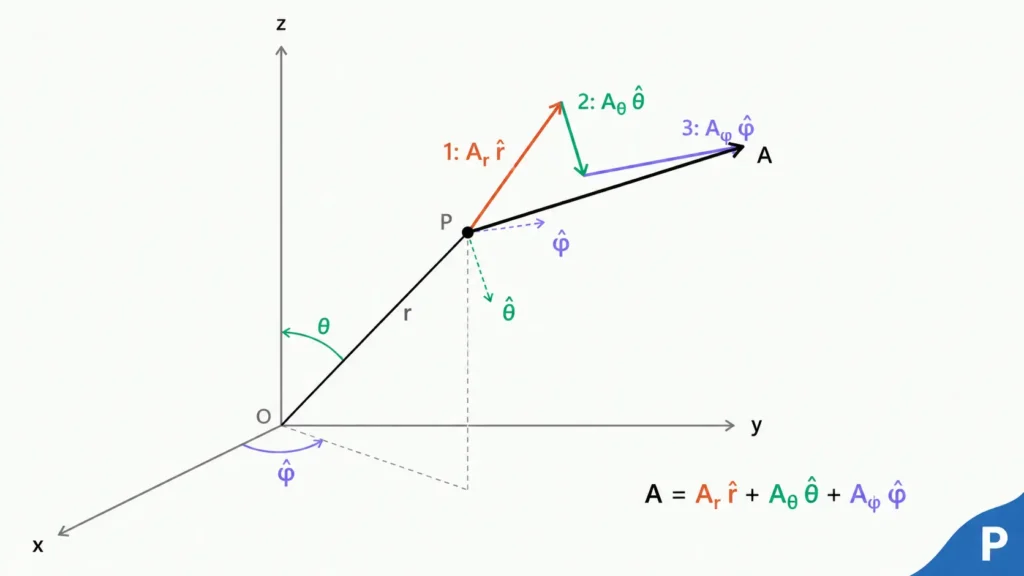
- Draw the component vector Ar in its radial direction.
- Add Aθ and Aɸ using head-to-tail vector addition, keeping each copied arrow parallel to its original direction.
- Draw the resultant from the tail of the first component to the head of the last component. This resultant vector is A.
Spherical Coordinates FAQs
1) What is z equal to in Spherical Coordinates?
z in spherical coordinates is equal to r × cosθ, i.e., z = r × cosθ.
Here, r is the radial distance from the origin in the spherical coordinate system, and θ is the polar angle.
2) What is Phi (ɸ) in Spherical Coordinates?
In physics, Phi (ɸ) is the azimuthal angle in spherical coordinates. It measures how far we rotate around the z-axis, starting from the positive x-axis (+x) in the xy-plane.
In mathematics, Phi (ɸ) is the polar angle in spherical coordinates. It measures the angle between the position vector and the positive z-axis (+z).
Note: The meaning depends on the convention being used. Physics commonly uses it for the azimuthal angle, while mathematics often uses it for the polar angle. Always check which convention your textbook follows.
3) What is r in Spherical Coordinates?
In spherical coordinates, r represents the radial distance from the origin to a given point. It is the straight-line distance between the origin and the point. In some conventions, ρ (rho) is used instead of r to represent this distance.
4) Can phi be negative in spherical coordinates?
Yes, Phi (ɸ) can be negative in spherical coordinates, depending on the convention being used. In physics, it is the azimuthal angle. It can be negative. For example, =-45° represents a rotation of 45°clockwise from the positive x-axis in the xy-plane.
In mathematics, it is the polar angle measured from the positive z-axis. Its standard range is , so it is not negative.
5) What is x^2+y^2 in Spherical Coordinates?
x^2+y^2 in spherical coordinates is equal to r2sin2θ. As you know,
x = r × sinθ × cosɸ
y = r × sinθ × sinɸ
Where θ is the polar angle, and ɸ is the azimuthal angle. Therefore,
x^2+y^2 = (x = r × sinθ × cosɸ )2 + (r × sinθ × sinɸ)2
= r2sin2θcos2ɸ + r2sin2θsin2ɸ
= r2sin2θ (cos2ɸ+sin2ɸ)
From trignometric identities we know that cos2ɸ+sin2ɸ = 1, so we have
x^2+y^2 = r2sin2θ
in spherical coordinates.

Pingback: What is a Coordinate System? Definition and Its Types