
If you’ve ever looked at a physics equation and wondered, Is this even correct?, You’re already thinking in the direction of dimensional analysis.
It is a quick checking method used to see if an equation or formula may be correct or undoubtedly incorrect. Instead of performing complex steps and heavy calculations to verify a formula, we use dimensional analysis to do this task in an easier and simpler way. It is also used to derive relations and convert units from one system to another. For example, force into dyne, meter into centimeter, and many others.
Despite its simplicity, it also has some limitations that must be understood.
In this article, we will discuss what dimensional analysis is, how this technique is used to perform different tasks with examples, and also its limitations.
What is Dimensional Analysis in Physics?
Dimensional analysis is the analysis that uses the idea of physical dimensions to check the validity of an equation, to derive relationships between different physical quantities, and to convert the units of a quantity from one system to another.
In simple terms, it is a method used to study the relationship between physical quantities by comparing their dimensions and in the conversion of units.
For example, it helps check equations like v = u+at to find out whether the relation is very likely correct or frmly incorrect.
It is also useful for finding relations between physical quantities, for example, determining how the time period of a simple pendulum is related to its length and gravitational acceleration. It can also be used for unit conversion, such as expressing a force of 3 N in dyne.
What are the Uses of Dimensional Analysis?
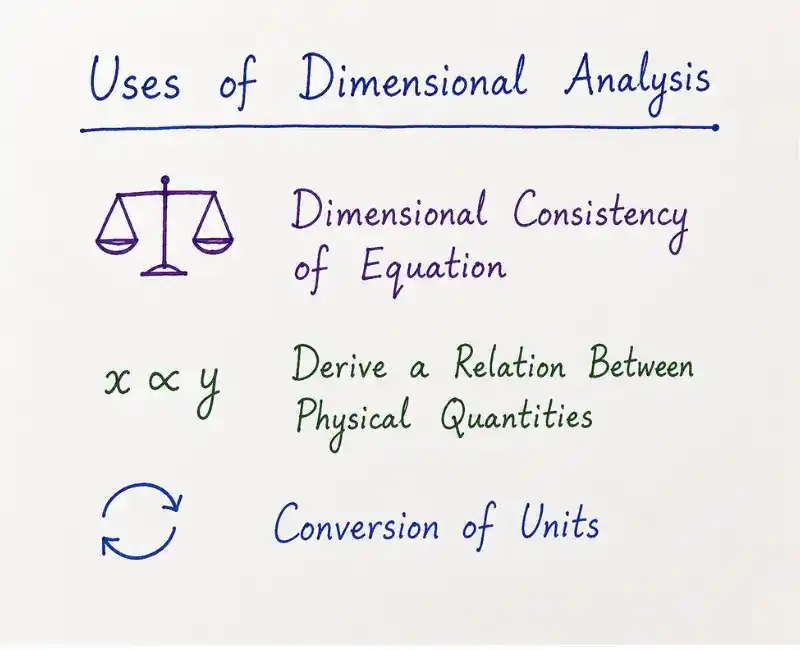
The main uses of dimensional analysis are:
- Dimensional Consistency of Equation
- Derive a Relation Between Physical Quantities
- Conversion of Units
1) Dimensional Consistency of Equation
An equation is said to be dimensionally consistent or dimensionally homogeneous if every term in it has the same dimensions. In simple words, it follows the principle of homogeneity of dimensions. This principle states that the dimensions on both sides of an equation must be the same, regardless of the form of the formula.
Based on this principle, we check whether an equation is dimensionally consistent or not. If an equation is dimensionally consistent, it may be correct. However, if it is not consistent, it violates the principle of homogeneity and is definitely incorrect.
Example
The most common example used to explain the principle of homogeneity is the second equation of motion:
where s is displacement, u is initial velocity, t is time, and a is acceleration.
Left-hand side (L.H.S):
[s] = [L]
Right-hand side (R.H.S):
[ut] = [LT-1][T] = [L]
[1/2 at2] = [LT-2][T2] = [L]
If,
L.H.S = R.H.S
[L] = [L] + [L]
[L] = [L]
As all the terms have the same dimensions and L.H.S = R.H.S., this equation holds the principle of homogeneity and is dimensionally consistent.
Note that the number ½ doesn’t contribute in this check. So, dimensional analysis cannot verify whether it is ½ at2 or 2at2.
In simple words, dimensional analysis can show when an equation is wrong, but it cannot prove that it is fully correct.
2) Derive Relation Between Physical Quantities
Dimensional analysis can also be used to derive relations if we know which quantities a certain physical quantity depends on.
To find relations using dimensional analysis, we need to know the dimensions of physical quantities. If it is hard to remember them, we should at least know the basic formulas of the involved quantities, because they can help us find the dimensions.
Example: Derive the formula of the Planck length using dimensional analysis. It depends on Planck’s constant ħ, the gravitational constant G, and the speed of light c.
1st step: As the Planck length depends on ħ, G, and c, we have
lp ∝ ħx Gy cz
2nd step: Remove the proportionality sign, and a proportionality constant k would appear. So, we have
lp = k ħx Gy cz
From experiments, it is found that the proportionality constant, which is Planck length, is 1, so it is dimensionless.
One important limitation is that dimensional analysis only works properly when the proportionality constant has no dimensions. For example, in the law of gravitation, the proportionality constant G has dimensions, so we cannot fully derive this formula using dimensional analysis.
3rd step: Write the dimensional formula of each quantity in the calculation formula, i.e.,
[lp] = [ħx] [Gy] [cz]
[L] = [ML2T-1]x [M-1L3T-2]y [LT-1]z
[M0L1T0]= [Mx-yL2x+3y+zT-x-2y-z]
4th step: Equate powers of the same dimensions on both sides
M: 0 = x-y ⇒ x = y
L: 1 = 2x+3y+z
T: 0 = -x-2y-z
As x = y from M, solving equations of L and T gives
1 = 2y+3y+z
1=5y+z
0= -y-2y-z
z = -3y
Put the value of z in 1=5y+z, we have
1=5y-3y
1=2y
y=1/2
It gives us the value of x and z as follows
From M,
x=y ⇒ x=1/2
From T, we have
z=-3y = -3 (1/2)
z = -3/2
Putting these values of variables in the Planck length formula, we have
lp = ħ1/2 G1/2 c-3/2
= √ħG/c3
3) Conversion of Units Using Dimensional Analysis
Here we’ll use the concept of dimensions to convert units from one system to another. Like from the SI system to the CGS system.
We already know that a physical quantity depends on a number and units, i.e.,
Physical quantity = n x u
If we convert a quantity from one unit system to another, the numerical value and unit change. But the physical quantity remains unchanged. In other words, the two expressions are equal in representing the same quantity. Like 5 m=500 cm. In general form, we can write it as
n1u1=n2u2
It is important to note that even though the numerical value and units change, the dimensions of the quantity remain unchanged. We’ll use this concept to convert units.
Example: Suppose we want to find the value of 1 kg/m3 in the CGS system. We need to convert units from kg/m3 into g/cm3.
Dimensional formula of density = [ML-3]
Density in SI units = 1 kg/m3
n1 = 1
M1 = kg
L1 = m
So, we have u1 = M1L1-3
Density in the CGS system = —g/cm3
n2 = ? (we’re finding this)
M2 = g
L2 = cm
Here, we have u2 = M2L2-3
As, n1u1=n2u2 and we need to find the value of n2, so we have
n2 = n1(u1/u2)
=1(M1L1-3/M2L2-3)
=(M1/M2)(L1/L2)-3
= (kg/g) (m/cm)-3
=(1000 g/g)(m/100 m)-3
= (1000)(10-2)-3 = (103)(10-6)
= (103-6)
n2 = 10-3
So, 1 kg/m3 density in the CGS system would be 10-3 g/cm3 or 0.001 g/cm3.
What are the Limitations of Dimensional Analysis?
In the previous section, we explored how useful dimensional analysis is. But it’s just as important to recognize its limitations, so you can judge when it will actually help and when it won’t.
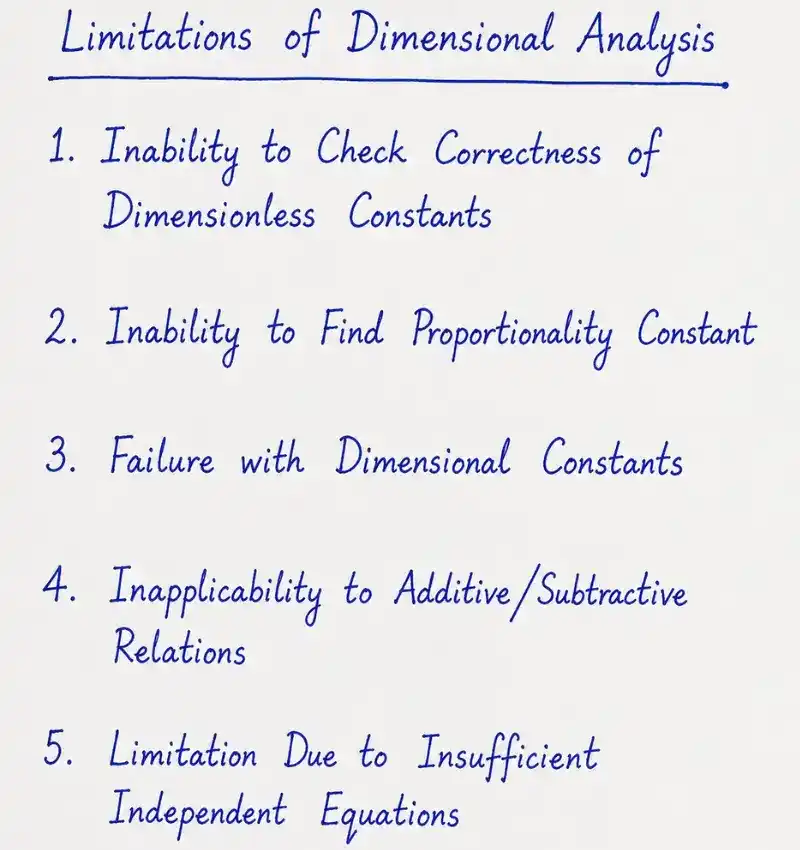
1) While checking the correctness of the equation using the homogeneity principle, it won’t be able to differentiate between ½ and 2 in the formula, as these are constant numbers.
For example, the 2nd equation of motion is s = ut+½ at2, even if it is written like s = ut+2at2, the homogeneity principle would show it correct. So, a dimensionally consistent equation doesn’t need to be correct, but if it is not consistent, it would definitely be wrong.
2) Deriving relations using dimensional analysis cannot find if there are any proportionality constants like 2, cosθ, 2π, e-m on which the formula depends.
For example, the time period of a simple pendulum, T = 2π √l/g. If you derive this formula using dimensional analysis, you would only get an expression like T = k √l/g, where k is a proportionality constant. It won’t tell anything about k; you have to find it experimentally.
3) Dimensional analysis cannot be used to derive a formula if the proportionality constant has dimensions, like the law of gravity.
This is because the method works by matching the powers of the same dimensions on both sides. A dimensional constant adds extra variables that we don’t know.
However, if physical constants are already included explicitly in the equation, dimensional analysis can still be used to check consistency. Like the mentioned example of finding the formula for the Planck length.
4) Deriving a relation using dimensional analysis doesn’t work if the relation contains addition or subtraction, like in 2nd equation of motion. It would only derive relations correctly if all the quantities are in multiplication or division form.
5) This method of deriving relations works only when the number of unknown exponents is less than or equal to the number of independent exponent equations.
In mechanics, there are only three fundamental dimensions (M, L, T), so equating exponents can provide at most three independent equations. If a physical relation involves more than three independent variables (or quantities), the number of unknowns exceeds the number of equations, and the system becomes underdetermined.
In such cases, dimensional analysis cannot uniquely determine the relation, although it may still suggest a possible functional form.
6) While deriving a relation, dimensional analysis cannot determine the exact form of dimensionless quantities like m1/m2. It may tell you a ratio exists, but not how it appears in the formula. It could be m1/m2, (m1/m2)2, sin(m1/m2) or could be anyother form.
Dimensional Analysis Practice Questions (Try Yourself)
1) Check if this equation is correct: v = u + at²
2) Derive the formula of the Planck time using dimensional analysis. It depends on Planck’s constant ħ, the gravitational constant G, and the speed of light c.
3) Convert
- 10 g into mg
- 72 km/h into m/s
- 2500 cm into meters
- 1 N into dyne
- 1 Pascal into dyne/cm2
using dimensional analysis.
