
Convert Rectangular to Spherical Coordinates Calculator
Use this rectangular to spherical coordinates calculator to convert Cartesian coordinates (x, y, z) into spherical coordinates (r, θ, φ). Enter your values to get accurate results with formulas and step-by-step solutions.
Step-by-step solution
θ = arccos(z/r) · polar angle from +z
φ = arctan(y/x) + quadrant corrections
θ: polar; φ: azimuth. Tiny values use scientific notation; only displays are rounded.
A point does not move when its coordinate system changes; only the way its position is described changes. Rectangular coordinates track movement along perpendicular axes, while spherical coordinates describe radial distance and two angles.
The rectangular to spherical coordinates calculator connects those views by turning three values into a distance and direction from the same origin.
For a practical example, a sensor may record a drone’s location through horizontal and vertical measurements, while a tracking device needs its azimuth and polar angle to aim correctly.
Before comparing results, check which symbols represent each angle and whether the display uses degrees or radians. That small check helps prevent a correct conversion from being read the wrong way.
How to Use Rectangular to Spherical Coordinates Calculator
Check the coordinate order before reading the answer: this calculator returns spherical coordinates as (r, θ, φ). Here, θ is the polar angle measured from the positive z-axis, while φ is the azimuth angle measured around it.
- Enter your rectangular coordinates into the x, y, and z boxes. Keep all three values in the same measurement unit.
- Choose your angle units and decimal places for output, then select the azimuth angle range: 0° ≤ φ < 360° for nonnegative angles, or −180° < φ ≤ 180° for signed angles. Both ranges describe the same directions; for example, 270° corresponds to -90°.
- Select “Convert Rectangular to Spherical” or press Enter to display the radial distance and both angles alongside the graph.
- Check the step-by-step solution to follow the calculations. Select Copy result to save the answer.
For a quick example calculation, select “Negatives” to see how negative inputs affect the angles. Select “Reset” to clear the entries before converting another location.
How to Convert Rectangular to Spherical Coordinates?
A point keeps the same location when its description changes from three distances (x, y, z) to a radius and two angles. The main challenge is choosing angles that place it in the correct part of 3D space.
- Set the convention: use r for radius, θ for inclination, and φ for azimuth measured from the positive x-axis.
- Find the distance from the fixed origin: take the square root of the sum x2 + y2 + z2.
- Find the tilt from the positive vertical axis using θ = arccos(z/r).
- Find the turn across the XY plane using atan2(y, x). This checks both signs. If you want to use the ordinary arctan formula, which is arctan(y/x), do quadrant sign adjustment with it as well. Otherwise, it can place the point in the wrong quadrant.
For every calculation, keep radians and degrees consistent. When the radius is zero, both angles are undefined; on the vertical axis, the azimuth is arbitrary.
Derivation of Cartesian to Spherical Conversion Formulas
The direction of a point needs careful attention: opposite points can produce the same ratio (y/x). A reliable derivation must preserve the signs of the Cartesian coordinates, as well as the distance from the origin.
These formulas follow the physics convention: r represents distance, θ measures the angle from the positive z-axis, and φ measures rotation around it. Other conventions may exchange the angle symbols, so their definitions matter.
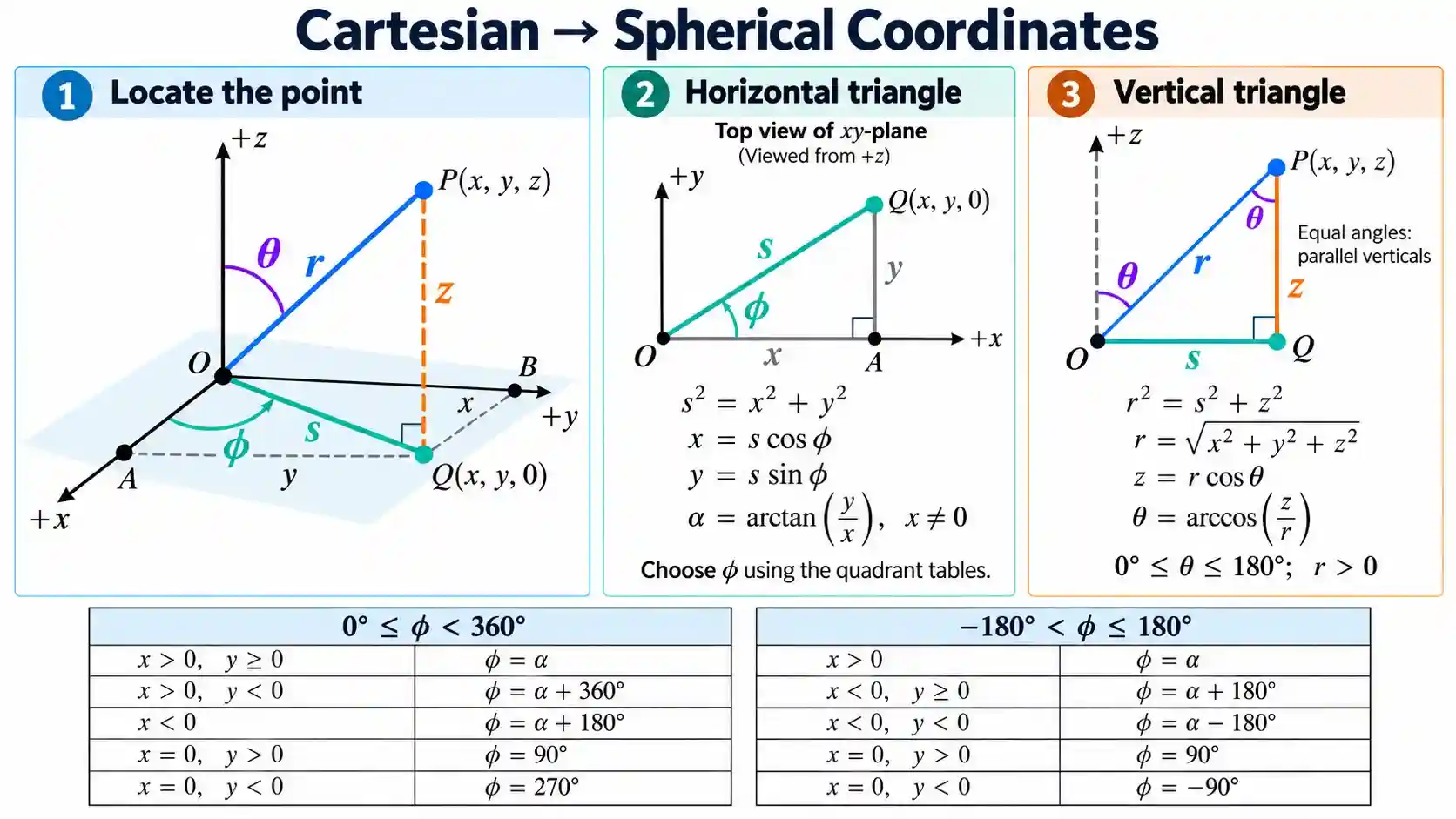
Deriving Radial Distance r Formula:
For a point P with three coordinates (x, y, z), its horizontal projection is (x, y,0). Taking the xy-plane as the reference plane, let s represent the distance from the origin to that projected point:
s = √(x2 + y2)
The horizontal triangle follows 2D polar coordinates. In this 2D view, the positive x-axis supplies the reference direction, and φ increases counter-clockwise when viewed from above the positive z-axis.
Now consider the right triangle with horizontal leg s, vertical leg z, and the position vector as its sloping side. The magnitude of this vector is the Euclidean distance from the origin:
r2 = s2 + z2
Substituting s2 = x2 + y2 gives the radial coordinate:
r = √(x2 + y2 + z2)
Deriving Polar Angle θ:
The positive z-axis points in the zenith direction. Measuring θ from this zenith makes it the zenith angle, also called the inclination angle.
The vertical component therefore satisfies z = r cosθ. Dividing by the distance and applying inverse cosine gives:
θ = arccos(z / r), where r > 0.
This angle ranges from zero to π radians, or 180°, covering points above and below the xy-plane.
Deriving Azimuthal Angle φ:
The azimuth angle φ comes from the horizontal projection of the point onto the xy-plane. This creates a right triangle with horizontal component x, vertical component y, and distance s from the origin.
Using simple trigonometry, the two components are:
x = s cosφ, y = s sinφ
Dividing the second equation by the first eliminates s:
y/x = (s sinφ)/(s cosφ) = tanφ
Applying inverse tangent to both sides gives the basic expression:
φ = arctan(y / x)
However, this expression needs a quadrant check. For example, (x, y)=(4, 4) and (-4, -4) give the same ratio, although their directions differ by 180°.
Let α = arctan(y/x). To express the azimuth between zero and 360°, use:
- φ = α, if x > 0 and y ≥ 0
- φ = α + 360°, if x > 0 and y < 0
- φ = α + 180°, if x < 0
When x = 0, division is undefined: the azimuth is 90° for y>0, or 270° for y<0. If both horizontal components are zero, the azimuth arbitrary case applies because the point lies on the z-axis.
For the range -180° < φ ≤ 180°, let α = arctan(y/x), then use:
- φ = α, if x > 0
- φ = α + 180°, if x < 0 and y ≥ 0
- φ = α − 180°, if x < 0 and y < 0
When x = 0:
- φ = 90°, if y > 0
- φ = -90°, if y < 0
- φ is undefined if y = 0
Here, 180° is included and -180° is excluded because they represent the same direction.
Two special cases complete the derivation. On the z-axis, the horizontal direction is undefined, making the azimuth arbitrary; at the origin, radius zero means neither angle has a unique value.
Rectangular to Spherical Calculator FAQs
1) What is the relationship between rectangular and spherical coordinates?
Both Rectangular and spherical coordinates are types of coordinate systems used to describe the same point in three-dimensional space. The Cartesian system uses distances along three orthogonal axes: x, y, and z. The spherical system uses radial distance r, polar angle θ, and azimuthal angle φ. You can convert Spherical to Cartesian coordinates and vice versa.
2) Can I convert 2D rectangular coordinates to spherical?
Yes. You can convert 2D rectangular coordinates (x, y) to spherical coordinates by setting z = 0. Calculate r = √(x2 + y2) and azimuth = arctan(y / x), plus adjusting for the correct quadrant. The polar angle is 90°. When x = 0, handle azimuth separately. At the origin, both angles are undefined.
3) How do I convert (2, 3, 8) to spherical coordinates?
For (x, y, z) = (2, 3, 8), use conversion formulas and calculate:
- Radius: r = √(2² + 3² + 8²) = √77 ≈ 8.775
- Azimuth: φ = arctan(3/2) ≈ 56.31° (No Quadrant adjustment needed)
- Polar angle: θ = arccos(8/√77) ≈ 24.26°
The spherical coordinates are (r, θ, φ) ≈ (8.775, 24.26°, 56.31°), with θ measured from the positive z-axis.
