
Convert Polar to Cartesian (Rectangular) Coordinates
You can reach the same point on graph paper whether its position is described by a distance and an angle or by horizontal and vertical offsets. The useful question is which description makes the next task easier. When Cartesian coordinates are more practical, but the position is given in polar coordinates, this polar to cartesian (rectangular) converter handles the conversion.
Polar coordinates describe a location using distance measured from the origin and an angle relative to a fixed direction.
Cartesian coordinates describe that location using horizontal and vertical offsets. This conversion connects the two descriptions without moving anything. They are also known by the name rectangular coordinates.
The formulas split the original length into its sideways and upward parts. Before calculating, check whether the turn is given in degrees or radians; choosing the wrong setting changes the answer even when every number is entered correctly.
What Are Polar and Cartesian Coordinates?
A point does not move when its label changes: Cartesian coordinates and polar coordinates describe the same position using different measurements. Both are coordinate systems for locating points in a plane.
In Cartesian notation, (x, y) gives two signed measurements: x tells how far right or left the point lies, and y tells how far above or below the origin it lies. The origin is where the two perpendicular axes meet.
In polar notation, (r, θ) describes the point through distance and angle. For a nonnegative r, this value gives the distance from the origin, while θ gives the angle measured from the positive x-axis, with positive angles measured counterclockwise.
Cartesian coordinates are convenient for grid layouts and straight lines, while polar coordinates can make rotations easier to describe. For a robotic arm turning around a fixed base, the reach and turning angle directly describe where its tip sits.
How to Convert Polar to Cartesian (Step by Step)
Treat the answer of converting polar to Cartesian as two movements: horizontal and vertical. A radius and polar angle locate the same spot as 2D coordinates.
- Start with (r, θ), where r gives the radial distance from the pole and θ measures the angle from the positive x-axis.
- Picture a right triangle joining the point to the horizontal axis. Its hypotenuse is r, while its base and height give the Cartesian components.
- Use cosine to find the horizontal component: x = r × cos(θ).
- Use sine to find the vertical component: y = r × sin(θ).
- Evaluate both expressions, then write the result as (x, y). Their signs place the point in the correct quadrant.
For (2, π/3), the steps give (1, 1.732) in the first quadrant. To preserve accuracy, round at the very end.
How to Use the Polar to Cartesian Calculator?
To use the polar to Cartesian calculator, follow the step-by-step procedure given below:
- Start with (5, 30°) under “Try an example” to preview the calculator. The outputs should be about (4.330127, 2.5), giving a useful check before entering your own values.
- Type the radius into “Radius r” and the polar angle into “Angle θ.” A radius in millimeters produces coordinates in millimeters.
- Select Degrees or Radians beside the angle field. For π/4, choose Radians or enter “π/4 rad“; a unit suffix overrides the dropdown.
- Choose 3, 6, or 9 decimal places under “Result precision,” then press “Convert Polar to Cartesian.” Extra digits help when checking small differences between results.
- Read the pair below the form, then compare the plotted point with the step-by-step solution. Press Reset to clear the fields for another calculation.
Derivation of Polar to Rectangular Conversion Formulas
The formulas x = r cosθ and y = r sinθ turn a point’s distance and direction into rectangular coordinates: horizontal and vertical positions. Their meaning becomes clearer by starting with the point and drawing a right triangle beneath it.
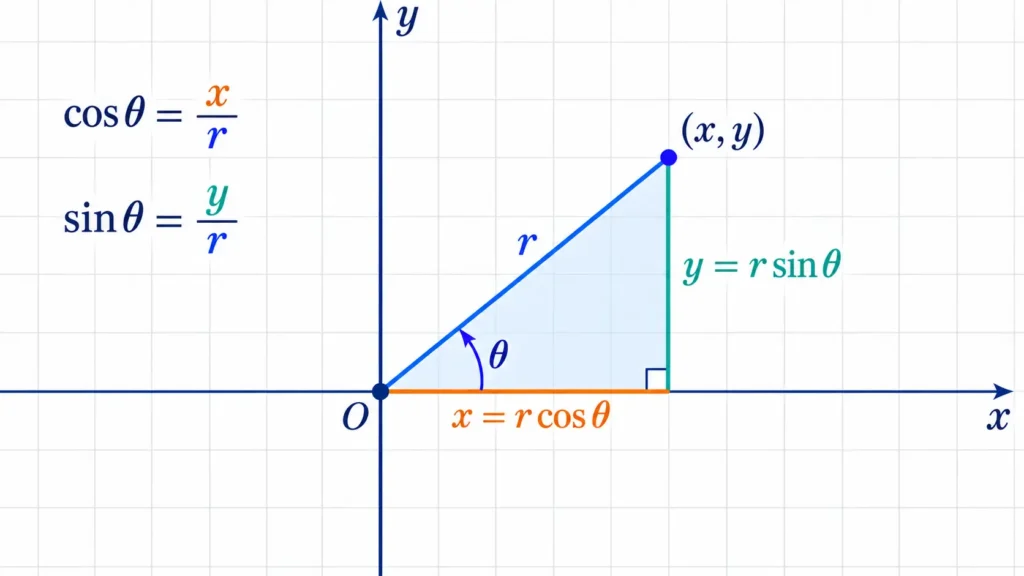
Take the polar axis as the positive horizontal axis, with θ measured counterclockwise from it. For a point in the first quadrant, draw a perpendicular down to the x-axis.
The sloping side is the hypotenuse, with length r. The horizontal and vertical legs give x and y, respectively.
By definition, cosθ equals the adjacent side of angle θ divided by the hypotenuse:
cosθ = x / r
Similarly, sin(θ) equals the opposite side of the angle θ divided by the hypotenuse:
sinθ = y / r
Multiplying each equation by r on both sides gives r cos θ for the horizontal position and r sin θ for the vertical position:
x = r × cosθ
y = r × sinθ
Here:
- r gives the straight-line distance between the point and the coordinate origin.
- θ (theta) specifies the angle from the positive x-axis to the line joining the origin and the point.
- x indicates how far left or right the point lies relative to the origin.
- y indicates how far above or below the origin the point lies.
The sketch starts in one quadrant, but these equations work in all four quadrants because sine and cosine include direction through their signs. The same rule still applies: cosine gives x, and sine gives y, while signs change to produce negative coordinates where needed.
Substituting zero into the final polar to Cartesian equation gives (0, 0) for every angle, since a point with no distance from the origin has no horizontal or vertical displacement.
Polar to Cartesian Conversion Examples
A negative horizontal value can be correct: (6, π/3) becomes (3, 3√3) or (3, 5.196), while changing the angle to 120° gives (−3, 3√3) or (-3, 5.196). The distance stays six, but the point moves left.
For any pair, use x = r · cos(θ) and y = r · sin(θ). With (1, π/4), both values equal √2/2 or 0.707, placing the point on the unit circle halfway between the positive axes.
For a workshop example, take r = 100 mm and θ = 45°. The results are x = 70.7 mm and y = 70.7 mm, showing the horizontal and vertical travel needed to reach that position.
Before calculating, check degrees vs. radians: π/4 needs radian mode, while 45° needs degree mode. Keep full values during calculations and round at the very end to avoid shifting the final position unnecessarily.
Angle Units: Degrees vs. Radians
A correct formula can still give the wrong coordinates when the angle mode is wrong. For hand work and drawings, degrees are often easier to read; in programming, many sine and cosine functions expect radians.
A rotation through half a circle equals 180° in degree notation and π in radians. To express a degree value in radians, multiply it by π/180. For the reverse conversion, multiply the radian value by 180/π.
Always check which unit the function expects before entering a value.
For example, 30 degrees requires degree mode, while its radian equivalent is π/6. Prevent a mismatch by checking the calculator’s or function’s documentation, and use the π button when available to preserve numerical precision instead of rounding too early.
Angle Convention, Quadrants and Negative Angles
An angle of -30° and an angle of 330° locate the same point when the radius stays positive. The convention sets the zero angle along the positive x-axis; turning counter-clockwise increases the angle, while turning clockwise makes it negative.
Check the quadrant before calculating: coordinate signs run Q1 (+, +), Q2 (-, +), Q3 (-, -), then Q4 (+, -). These quadrant sign changes follow x = r cos θ and y = r sin θ.
Keep negative r separate from a negative angle: it places the point on the other side of the origin. For example, (2, -90°) gives (0, -2), while (-2, -90°) gives (0, 2). An angle of −180° reaches the same direction as +180°.
Common Mistakes of Polar to Cartesian Conversion
- Check angle mode before trusting a result. A degrees-radians mismatch can produce believable numbers that describe the wrong position.
- Treat negative x and negative y as location clues, not errors. Check their signs against the expected quadrant before changing either value.
- Keep extra digits during calculation; round only the final answer. Careful floating-point handling can affect the last digit, so tiny differences do not automatically signal a mistake.
- Repeatedly converting back and forth can compound rounding differences. A change of ±1 in the last digit may reflect rounding rather than faulty formulas.
- A weak π approximation, such as 3.14, can shift calculated positions. Use stored π; 3.1416 improves precision but still rounds the constant.
Real-World Application of Polar to Rectangular Conversion
Weather radar detects a storm by measuring its distance and direction from the radar station. A satellite map, however, needs horizontal and vertical coordinates to place that storm correctly.
Suppose the storm is 100 km away at an angle of 30° north of east. Polar to Cartesian conversion gives its position:
x = 100 cos(30°) ≈ 86.6 km east
y = 100 sin(30°) ≈ 50 km north
These coordinates tell the mapping software exactly where to display the storm relative to the station. As new measurements arrive, the software repeats the conversion to update its location in real time.
The conversion connects what the radar measures, distance and angle, with what the map displays, horizontal and vertical position. This helps weather teams track the storm’s movement and identify places along its path.
Polar to Cartesian Converter FAQs
1) What are the Cartesian coordinates of (1, π/4)?
For (1, π/4), the Cartesian coordinates are (√2/2, √2/2) or (0.707107, 0.707107). The 45° angle follows the first-quadrant bisector, giving equal components: x = 1 × cos(π/4) and y = 1 × sin(π/4).
2) Are polar coordinates unique?
Polar coordinates are not unique: an integer multiple of 2π added to an angle leaves the point unchanged. A full turn measures 2π radians. At the origin, every angle identifies the same point.
3) How to Handle Negative Coordinates in Polar Conversion?
Keep the minus sign when using x=r cosθ and y=r sinθ. A negative angle turns clockwise. To rewrite a negative radius as positive, use its absolute value and add 180° to the angle; both forms locate the same point.
4) When to use degrees versus radians?
Use degrees for everyday angle measurements, navigation, and geometry, especially when describing turns or directions. Use radians in calculus, physics, and advanced mathematics because they simplify formulas involving rotation, waves, and trigonometric derivatives. A full circle equals 360° or 2π radians; 180° equals π radians.
5) Can a Polar to Cartesian Converter be Used for 3D Coordinates?
This polar to cartesian converter works with two-dimensional points, turning a radius and an angle into x and y coordinates. It does not calculate a third coordinate, z. For points in 3D space, use a converter designed for spherical or cylindrical coordinates, depending on how your values are given.
