
Rectangular to Polar Calculator
Enter the Cartesian coordinates (x, y) to find the point’s polar coordinates (r, θ). This rectangular to polar calculator shows the radius, angle, graph, and step-by-step conversion so you can follow the calculation.
Your rectangular coordinates
Enter the x and y coordinates of your point.
Your polar coordinates
Quadrant IIThe polar coordinate plane
Step-by-step solution
Changing how a point is described does not change where it lies. A Rectangular to Polar Calculator turns rectangular (Cartesian) coordinates into a distance and an angle, giving the same position a different description.
This view is useful in navigation and robotics, where how far something is and which way it faces often matter more than separate horizontal and vertical measurements.
Polar coordinates express these as a radius and an angle: the radius tells you how far the point lies from the origin, and the angle locates its direction relative to the positive x-axis.
One detail deserves attention: the signs of x and y determine the quadrant. Checking that relationship helps prevent a correct distance from being paired with the wrong direction.
How to Use the Rectangular to Polar Calculator
To use rectangular coordinates to polar coordinates heck the settings before entering a point. The selected angle unit and range determine how the answer appears.
Step 1: The calculator is set to the most common setting, i.e., degrees and 0°≤ θ <360°. Use the unit drop-down to choose degrees or radians, then select the angle range your question requires. These choices affect how the answer appears.
Step 2: Next, enter x and y in their designated fields. Each must be a real number; keep negative signs and convert values into the same units for both measurements.
Step 3: Set the decimal places to control the precision shown. More decimal places help when comparing nearby points, but they do not make the original measurements more precise.
Step 4: Press “Convert Rectangular to Polar” or “Enter” on the keyboard. Read r as the distance from the origin and θ as the direction in your selected angle unit.
Step 5: Use the live graph for a quadrant check, then review the intermediate values to follow the working. Both coordinate signs affect the direction.
Step 6: For (0, 0), the distance is zero, and the direction is undefined.
Before copying the answer, check its angle unit and decimal places. Use Reset to restore the default settings before trying another point.
Why Use This Rectangular to Polar Calculator?
A plausible result can still point in the wrong direction. This calculator helps check the correct angle when negative x or negative y makes a manual answer harder to judge.
Use the step-by-step solution to compare your working, then check the live graph to see where the point lies. Choosing degrees or radians also helps keep the result consistent with the rest of your work.
Rectangular vs Polar Coordinates
A point stays in the same place when its description changes. The choice depends on which measurements make the problem easier to describe.
| Rectangular | Polar |
|---|---|
| Cartesian coordinates use two perpendicular axes. | Polar coordinates use a non-negative distance from the origin and an angle measured from a reference axis. |
| (x, y) records horizontal distance and vertical distance, with signs showing direction. | (r, θ) records distance and angle. |
| Rectangular coordinates suit straight-line relationships. | Polar notation often simplifies circular motion and rotational motion. |
Usually, θ is a counterclockwise angle from the positive horizontal axis. Adding full rotations changes the angle’s written value without changing the point. At the origin, the angle is undefined.
How to Convert from Rectangular to Polar Coordinates (Step-by-Step)
Distance alone cannot locate a point: its direction matters too. Converting (x, y) into (r, θ) combines the radial distance with a polar angle measured from the positive x-axis.
1) Identify the horizontal and vertical values. Keep their signs, because these determine which quarter of the coordinate grid contains the point.
2) Find the distance using the Pythagorean theorem: r = √(x2 + y2). Squaring removes negative signs, so the distance cannot be negative.
3) Find the direction with θ = atan2(y, x). The atan2 function handles all quadrants and points on either axis without dividing by zero.
4) Check the angle mode before reporting the answer. For radians to degrees, use deg = rad × (180/π); if the angle is negative and an answer from 0° up to, but excluding, 360° is required, add 360°.
5) Write the distance first and angle second. For (3, 4), the calculations give r = 5 and approximately 53.13°, producing (5, 53.13°).
Keep extra digits during the calculations and round only the final answer. At the origin, the distance is zero, but the direction is undefined because no single angle identifies it.
Derivation with Rectangular to Polar Conversion Formulas
A distance alone cannot locate a point: points in opposite quadrants can sit equally far from the origin. Expressing an ordered pair (x, y) in polar form therefore requires both a distance r and an angle θ.
The distance comes from the straight line connecting the origin and the point. Its length is the radius r, while θ measures the turn from the positive horizontal reference axis, with counterclockwise taken as positive.
Deriving Formula for Radius r
The horizontal offset x and vertical offset y lie along two perpendicular axes. Drawing a perpendicular from the point to the horizontal axis forms a right triangle whose side lengths are |x|, |y|, and r.
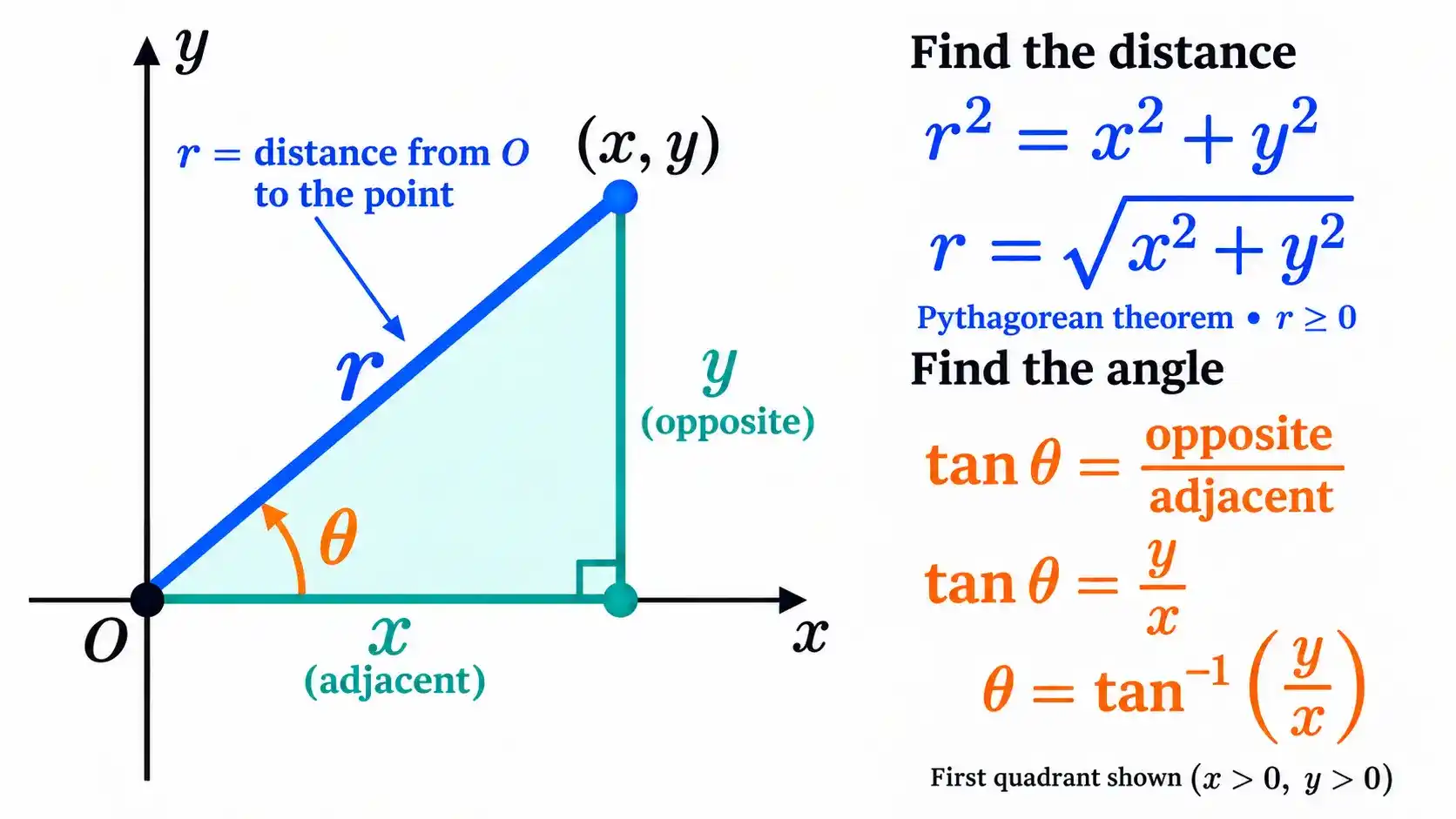
By the Pythagorean theorem:
r^2 = x^2 + y^2
Taking the non-negative square root gives the distance formula:
r = √(x^2 + y^2)
The condition r ≥ 0 matters because r represents a distance. Squaring the coordinates also means that negative coordinates contribute correctly to this magnitude.
Deriving Formula for Angle θ
From the graph, when x > 0 & y > 0, using x and y gives
tanθ = y / x
Applying inverse tangent gives θ = arctan(y / x), also written as:
θ = tan^-1 (y / x)
Arctan, also written as tan-1, returns angles only between -90° and +90°, so it cannot directly give angles in Quadrants II and III. To identify these cases, check x: when x < 0, add 180° to the result to place the angle in the correct quadrant. For an angle from 0° up to, but excluding, 360°:
- When x > 0 and y ≥ 0, use θ = arctan(y/x).
- When x < 0, add 180°, giving θ = arctan(y/x) + 180°.
- When x > 0 and y < 0, use θ = arctan(y/x) + 360°.
For an angle in the range -180° < θ ≤ 180°:
- When x > 0, use θ = arctan(y/x).
- When x < 0 and y ≥ 0, use θ = arctan(y/x) + 180°.
- When x < 0 and y < 0, use θ = arctan(y/x) – 180°.
- When x = 0 and y > 0, θ = 90°.
- When x = 0 and y < 0, θ = -90°.
- When x = 0 and y = 0, the angle is undefined.
Here, the negative horizontal axis is represented by 180°. The angles -180° and 180° describe the same direction.
Why the Quadrant Matters? (atan2 vs. arctan)
A correct ratio can still point to the wrong quadrant. For (-3, -4), dividing y by x gives 4/3, so single-argument arctan returns about 53.13°, suggesting Quadrant I instead of Quadrant III.
The missing information is the signs of both inputs. atan2(y, x) keeps those signs and places this point in the third quadrant, at 233.13° after normalization. Some implementations return negative angles, so check the output convention.
Use this rule for θ when checking the range of θ: Quadrant I, 0°-90°; Quadrant II or second quadrant, 90°-180°; Quadrant III, 180°-270°; Quadrant IV, 270°-360°. These intervals exclude the axes.
If you don’t want to use the function atan2(y,x), you need to add/subtract some angle from arctan(y/x) to place the point in the correct quadrant.
The radius is always positive away from the origin; it cannot identify the quadrant by itself.
Rectangular to Polar Conversion Examples
Start with three points that expose the main conversion checks: distance, quadrant, and axis position.
For x = 3 and y = 4, substitute values into r = √(32 + 42) to obtain 5. Next, θ = arctan(4/3) gives θ ≈ 53.13°, so the polar result is (5, 53.13°).
With (-3, 4), the radius stays unchanged at 5. However, the point lies in quadrant II, so its angle is 180° – 53.13° = 126.87°. The result is (5, 126.87°).
For (0, -5), the point sits directly below the origin. Its radius is 5, and its angle is 270°, giving (5, 270°).
These examples show why matching distances does not guarantee matching directions. When checking homework, use both signs to identify the quadrant before accepting the angle shown in the calculator’s display.
Real-Life Applications of Rectangular to Polar Conversion
Rectangular to polar conversion changes horizontal and vertical distances into a distance and direction. This is useful in real life when a device needs to know how far to reach and which way to turn, and you only have its horizontal and vertical distances.
A robot may know that an object is 3 feet to its right and 4 feet ahead. Rectangular to polar conversion tells it that the object is 5 feet away, at about 53° from the rightward direction, so it knows which way to turn and how far to move.
In a game, converting an enemy’s position relative to the player gives a distance and direction. These values help point an on-screen arrow toward the enemy.
A camera system can convert an object’s horizontal and vertical offsets in an image into its distance and direction from the image center. The direction helps guide camera movement.
Rectangular to Polar Calculator FAQs
1) Are Cartesian coordinates the same as rectangular coordinates?
Yes, Cartesian coordinates and rectangular coordinates mean the same thing. They locate a point using perpendicular axes, with coordinates written as (x, y) in two dimensions or (x, y, z) in three dimensions. “Cartesian” honors René Descartes, while “rectangular” describes the right angles between the axes.
2) Why are rectangular to polar conversions useful?
Rectangular to polar conversions make problems involving circles, rotation, and angles easier to solve. While rectangular coordinates describe horizontal and vertical positions, polar coordinates show distance and direction from the origin. This is useful in navigation, robotics, physics, and engineering, where circular motion or radial relationships often appear.
3) What are the formulas for converting Cartesian to polar form?
To convert Cartesian coordinates (x, y) to polar form (r, θ), use the following formulas:
r = √(x2 + y2)
θ = arctan (y / x) + Quadrant adjustments
Here, r is the distance from the origin. Adjust for the correct quadrant; when x = 0, determine the angle directly from the y-axis.
