
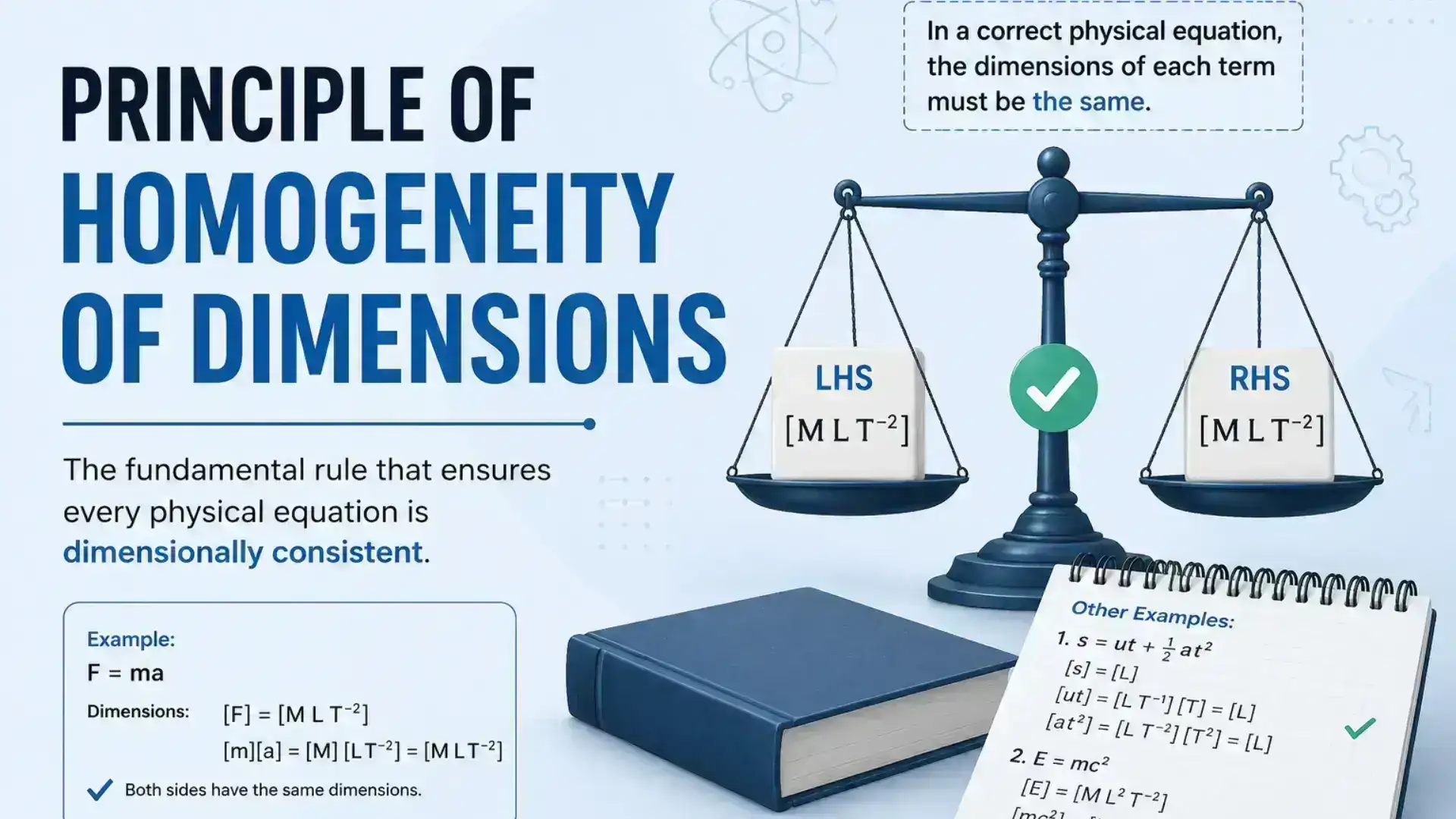
The principle of homogeneity of dimensions is a rule in dimensional analysis in physics to ensure the consistency of equations. For any law of physics to be valid, it must follow this principle.
It offers a fast and reliable method to check whether a given equation is correct dimensionally by verifying whether all terms have consistent dimensions. It can also be used to determine the dimensions of unknown variables in an equation.
This article is written to help you understand the principle of homogeneity by discussing its different use cases with examples.
What is the Principle of Homogeneity of Dimensions in an Equation?
This principle states that
All the terms on both sides of an equation must have the same dimensions or dimensional formula.
In other words, the left-hand side and right-hand side of the equation must match dimensionally.
Any Part of an equation separated by a plus (+) or minus (−) is known as a term. For example, x = 4+7s, here x, 4, and 7s are terms of the equation where x and s are pure numbers.
The core idea of this principle is that you can only add, subtract, or compare things if they are of the same kind. Just like you can add apples with apples, but not apples with mangoes.
Similarly, in physics, you can only combine physical quantities that have the same units or dimensions. For example, you can add length to length, and time to time, but you cannot add length to time because they are different kinds of quantities.
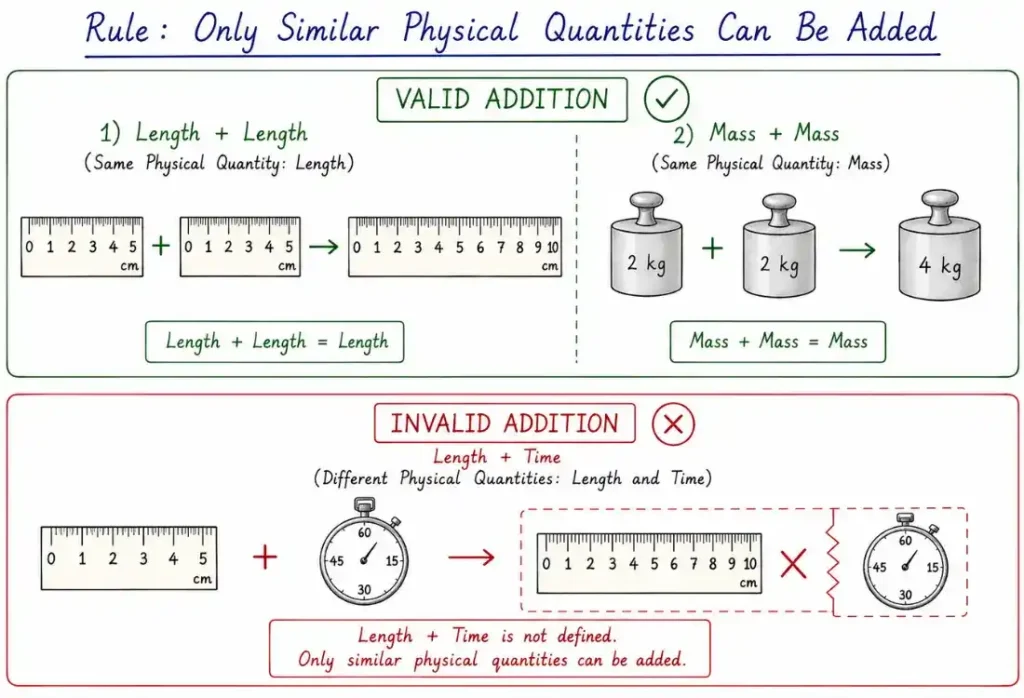
The equation that follows this principle is known as a dimensionally consistent or dimensionally homogeneous equation.
The homogeneity principle not only applies to physical equations but also to physical inequalities (<, >, ≤, ≥). For example, v ≤ c, where v is the speed of an object or particle, and c is the speed of light. Both have the same dimensions, so the inequality is dimensionally valid.
Note: Checking dimensional consistency serves the same purpose as checking the uniformity of units across all terms in an equation, but checking with dimensions offers a key benefit. Instead of converting everything into a common unit system, we simply compare the dimensions of each term, which makes the process quicker and more general. So, to check the uniformity of units in an equation, we check its dimensional consistency.
Applications of the Principle of Homogeneity of Dimensions
There are various applications of the principle of homogeneity of dimensions. Out of them, the most common are to:
- Check the correctness of the equation
- Find dimensions of unknown variables in an equation
1) Check the Correctness of the Equation
The most important and famous use of the principle of homogeneity is to check the correctness of a physical equation. If it is correct, we say the equation is dimensionally consistent or homogeneous.
Example 1:
Apply the homogeneity principle to check whether the famous equation of physics, E = mc2, is correct or not.
First, check the dimensions of the L.H.S. (left-hand side),
[E] = [ML2T-2]
Now, R.H.S. (Right-Hand Side):
[mc2] = [M][LT-1]2
= [M][L2T-2]
[mc2] = [ML2T-2]
If,
L.H.S. = R.H.S.
[E] = [mc2]
[ML2T-2] = [ML2T-2]
It shows that L.H.S. = R.H.S., which means this equation is dimensionally consistent, so it is correct.
Example 2:
Another case is the first equation of motion, written as v = u + at. In this formula, v represents the final velocity, u stands for the initial velocity, a is the acceleration, and t refers to time.
1st term: [v] = [LT-1]
2nd term: [u] = [LT-1]
3rd term: [at] = [LT-2] [T] = [LT-1]
Since all the terms in the given equation have the same dimension, it means the equation follows the homogeneity principle and is dimensionally consistent.
Example 3:
Check the homogeneity of the relation v = √(t x l/m).
In this expression, v denotes the speed of a transverse wave travelling along a stretched string. The symbol t represents the tension (force) in the string, l is the length of the string, and m is its mass.
Dimensions of L.H.S.
[v] = [LT-1]
Dimensions of R.H.S.
[√(t x l/m)] = ([t] x [l] / [m])1/2
Since tension t is force, so its dimensions are [MLT-2]. Therefore we have
= ([MLT-2] x [L] / [M])1/2
M in the numerator would cancel out with the M in the denominator. So, we have
= ([L2T-2])1/2 = [LT-1]
Hence,
[√(t x l/m)] = [LT-1]
As dimensions of L.H.S. = dimensions of R.H.S., the equation is dimensionally consistent and homogeneous.
Example 4:
Let’s take another example to see what the final result would look like when the equation is not dimensionally consistent.
Given equation is F = mv3/r
L.H.S.
[F] = MLT-2
R.H.S.
[mv3/r] = [m] [v3] [1/r]
= [M] [LT-1]3 [L-1] = [M] [L3T-3] [L-1]
[mv3/r] = [M] [L3-1T-3] =[M] [L2T-3]
[mv3/r] = [ML2T-3]
If,
L.H.S. = R.H.S.
[F] = [mv3/r]
[MLT-2] ≠ [ML2T-3]
As L.H.S. ≠ R.H.S., it means the equation is not dimensionally consistent, so it is not correct.
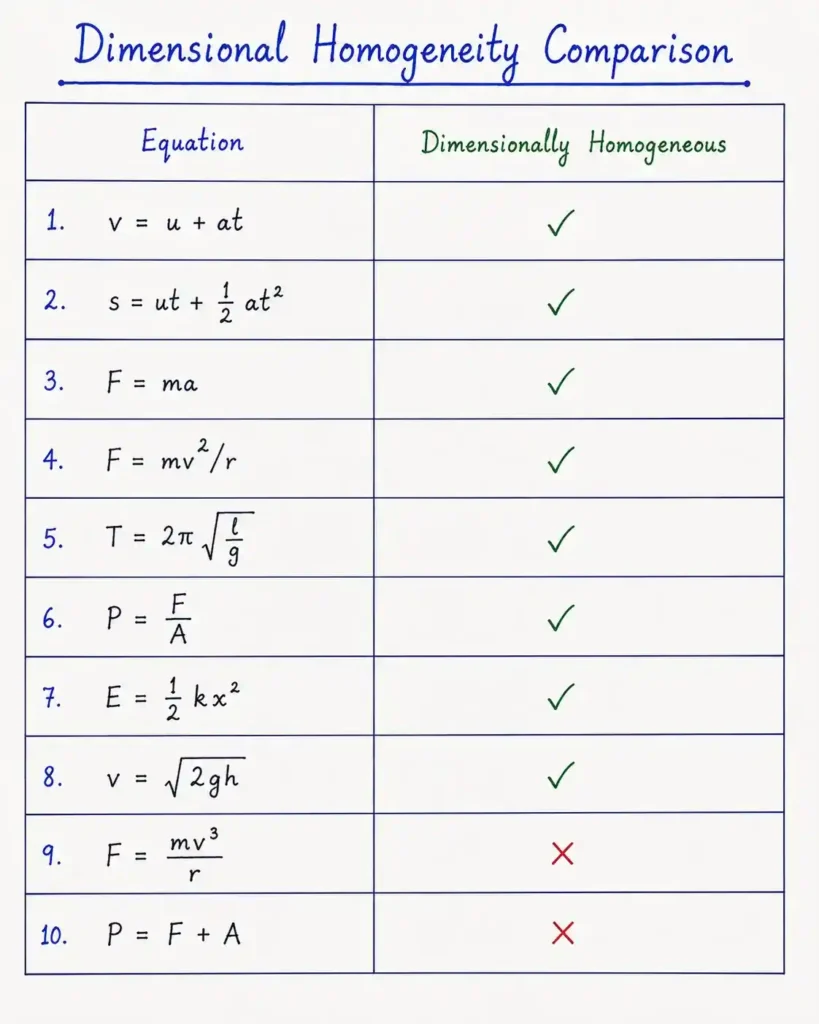
Limitation: If an equation is dimensionally homogeneous, we cannot say it is fully correct; we can only say it is dimensionally correct. This is because the principle does not give any information about numerical constants such as 2, 1/2, or π.
2) Finding Dimensions of Unknown Variables in an Equation
The homogeneity principle is also used to find dimensions of unknown variables in an equation. To find dimensions of unknown variables, the condition is that the equation must be dimensionally consistent. That is, it must follow the principle of homogeneity.
Let’s take a look at some examples to understand the process of determining unknown variables.
Example 1:
Determine the dimensions of variables a & b in v = a + bt, given that the equation is dimensionally consistent. Where v is velocity and t is time.
According to the principle of homogeneity, all the terms in an equation have the same dimensions. So, the dimensions of v, a, & bt are the same.
We know that [v] = [LT-1].
Since the dimensions of v and a are the same,
[a] = [LT-1]
Also,
[v] = [bt]
[LT-1] = [bT]
[LT-1/T] = [b]
[b] = [LT-2]
So, the dimensions of a and b are [LT-1] and [LT-2], respectively.
Example 2:
Determine the dimensions of a & b in P = a–t2/bs, where P is pressure, t is time, and s is distance. The equation is dimensionally consistent.
Since a and t2 are being subtracted, they must have the same dimensions. Because physical quantities can only be added or subtracted when their dimensions are identical.
So, [a] = [t2]
[a] = [T2]
And the numerator has dimensions
[a-t2] = [T2-T2] = [T2]
We know the relation P=F/A, in which F denotes force, and A denotes area. So, the dimensions of pressure are
So, [P] = [MLT-2] / [L2] = [ML1-2T-2]
[P] = [ML-1T-2]
The dimensions of (a–t2) / bs are the same as those of P. So,
[P] = [a–t2] / [bs]
[ML-1T-2] = [T2] / [b] [L]
Taking [b] to the left side and the dimensions of P on the right side, we have
[b] = [T2] / [L] [ML-1T-2]
L and L-1 will cancel each other, and when we take M and T-2 in the numerator, the powers will have opposite signs.
= [T2] [M-1T2]
[b] = [M-1T-4]
So, the dimensions of a and b are [T2] and [M-1T-4], respectively.
Example 3:
Determine the dimensions of A, ⍵, and k in y = A sin (⍵t-kx), where y is displacement, t is time, and x is distance.
Since both ωt and kx represent angles, they must be dimensionless quantities.
So, dimensions of ⍵t are
[⍵t] = [M0L0T0]
[⍵][T] = [M0L0T0]
Take [T] to the right side of the equation, so we have
[⍵] = [M0L0T-1] or [T-1]
Similarly, dimensions of kx are
[kx] = [M0L0T0]
[k][L] = [M0L0T0]
Take [L] to the right side of the equation,
[k] = [M0L-1T0] or [L-1]
Since the value of sin (⍵t-kx) gives a constant numerical value, it is dimensionless. So we can write from the given equation,
[y] = [A]
[L] = [A]
[A] = [L]
Hence, the dimensions of ⍵, k, and A are [T-1], [L-1], [L], respectively.
Limitation: You can determine the dimensions of an unknown quantity, but you cannot identify the physical quantity itself. This is because different physical quantities may share the same dimensions, such as work done and torque. Both have the dimensional formula [ML2T-2].
The homogeneity principle is also useful when you are unsure about a formula, for example, whether the correct relation is T = 2π√(l/g) or T = 2π√(g/l).
Rather than relying on guesswork, you can quickly verify the equation by checking whether both sides of the equation have the same dimensions. If the dimensions on each side are consistent, the equation is dimensionally valid, meaning all the quantities are correctly related. If they do not match, the expression must be incorrect.
The principle of homogeneity is essentially a part of dimensional analysis. Therefore, uses of the principle of homogeneity can also be considered uses of dimensional analysis.
