
In physics, base quantities make up all derived quantities.
By studying dimensions and their dimensional formulas, you can see how derived quantities are built from base quantities. You can also use this understanding to validate equations and derive relations.
In this article, we will discuss what dimension means in physical quantity, what a dimensional formula is, and how to derive it. Additionally, we will go through several examples to help students grasp and strengthen this concept.
What is the Dimension of Physical Quantity?
In physics, dimensions are the powers (or exponents) of base quantities obtained when a physical quantity is expressed in terms of base quantities.
For example, we express force as mass times acceleration, where acceleration is Length / Time2. When we express force in terms of base quantities, it becomes
It shows that the dimensions of force are 1 in mass, 1 in length, and -2 in time, because time is in the denominator. We express these dimensions in a dimensional formula using special symbols, such as [MLT-2].
The definition of dimensions of physical quantity often confuses students because they already understand the word dimension from mathematics, especially in geometry, differently.
In geometry, the word dimension is a purely abstract concept that denotes the number of independent coordinates or directions needed to specify a position or describe a shape. It has no units or physical meaning.
For example, a line is 1-dimensional, a surface 2-dimensional, and our space 3-dimensional. In other words, the number only tells how many directions exist, not anything about meters or seconds.
To move from abstraction to the physical world, however, each geometric direction must be measurable. We do this using a measurable quantity, Length (L). In this way, length gives physical meaning to each direction by answering “how far.”
So when you say a room is 4 meters long, 3 meters wide, and 3 meters tall, you are doing exactly this, taking the 3 abstract independent directions of geometric space and filling each one with a real, measurable length.
Similarly, a line in 1-dimensional space requires one length measurement. In physics, while discussing its dimensions, we represent it as L1. An area requires two independent length measurements, so it is L2. Likewise, volume requires three length measurements, so it is L3.
Thus, you can see that as we move from geometry to the real world, dimensions are expressed as powers of length.
Physics doesn’t just stop here. It deals with many kinds of measurements in the real world, but all of them are built from a few base quantities such as mass, length, and time. In fact, these basic quantities act as the starting point, because every other physical quantity is formed from them as shown in the diagram below:
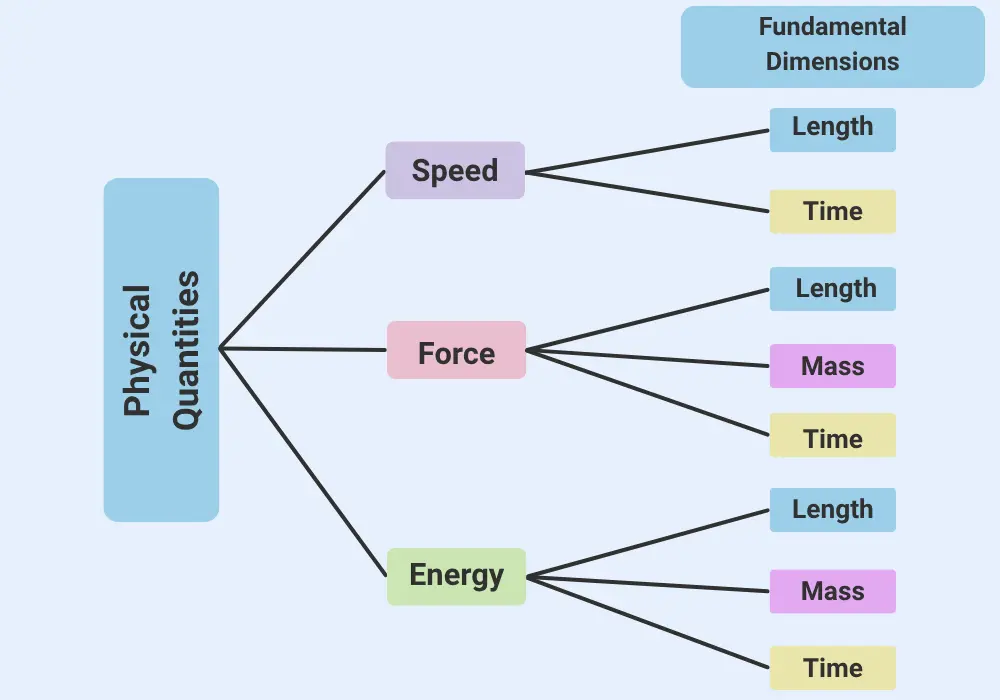
We therefore take these base quantities as the fundamental dimensions of the physical world.
We represent these fundamental quantities (or dimensions) using special symbols shown in the table below.
| Fundamental Quantities | Dimension Symbols |
|---|---|
| Length | L |
| Mass | M |
| Time | T |
| Temperature | Θ (or K) |
| Amount of Substance | N (or mol) |
| Electric Current | I (or A) |
| Luminous Intensity | J (or cd) |
Some textbooks use symbols that are different from the convention. I have written them in parentheses ( ) in the table above.
Whenever you see square brackets [ ] around a physical quantity, it means we are referring to the dimensions of that quantity.
The symbol of dimensions should be non-italic.
From the definition, you know that dimensions depend on the base quantities, and not on the unit system used. For example, you can express the area in m2, ft2, or cm2, but the dimensions would be the same, i.e., 2 in length.
The formula to represent a quantity may change, but the dimension remains the same. For example, the volume of a cube is l3, the volume of a sphere is 4/3 π r3, and the volume of a cylinder is π r2 h. The formula to represent a volume is changing each time, but the dimensions of volume remain the same, i.e., 3 in length.
What is Dimensional Formula of Physical Quantity?
The expression used to represent the dimension of a physical quantity in terms of base quantities is known as its dimensional formula.
In general form, we write dimensional formula of a quantity Q as
Similar to dimensions, the dimensional formula of a physical quantity remains the same, regardless of the particular formula used to calculate it. For example, the dimensional formula for a volume would always be [L3], the dimensional formula of an area would always be [L2].
How to Find Dimensional Formula of Physical Quantity?
To find the dimensional formula of any physical quantity, follow this step-by-step procedure
1) Identify the physical quantity whose dimensional formula you want to find.
2) Write the calculation formula used to calculate that quantity.
3) Express all quantities in the calculation formula in terms of base quantities (such as length, mass, and time). If the formula contains any derived quantities, keep breaking them down until only base quantities remain.
4) Replace each base quantity with its dimension symbol with appropriate powers.
5) Write the dimensional formula by following how the quantities are connected in the calculation formula and express them in square brackets [ ].
For example, you want to find the dimensional formula of work done.
The calculation formula for work done is
where
F = force
d = displacement (distance)
The term cosθ is the ratio of two sides of a triangle, so it has no units. Therefore, it is a dimensionless quantity, and we represent it as 1 in the dimensional formula.
If you know, force is given by
Further,
And, velocity = distance / time
So, the dimensional formula of velocity = [LT-1].
The dimensional formula of acceleration = [LT-1] [T-1] = [LT-2].
Dimensional formula of Force = [LT-2] [M] = [MLT-2]
Finally, the dimensional formula of Work done would be
W = Fdcosθ
[W] = [F][d]
= [MLT-2][L]
[W] = [ML2T-2]
This equation represents the dimensional formula of Work done. It has dimensions 1 in mass, 2 in length, and -2 in time. Also, this equation that we obtained by equating physical quantity W with its dimensional formula is known as a dimensional equation.
Examples of Dimensions and Dimensional Formula
Here is a list of physical quantities with their formula for calculation, dimensional formula, and dimensions.
Note: The dimensional formula of a physical quantity does not depend on a single calculation formula. If a quantity can be expressed using more than one calculation formula, you can use any of them to determine its dimensional formula.
| Physical Quantity | Formula for Calculation | Dimensional Formula | Dimensions |
|---|---|---|---|
| Force | MassAcceleration | [MLT-2] | 1 in mass, 1 in length, and -2 in time |
| Pressure | F/A | [ML-1T-2] | 1 in mass, -1 in length, and -2 in time |
| Energy or Work | Fdcosθ | [ML2T-2] | 1 in mass, 2 in length, and -2 in time |
| Velocity | Displacement / Time | [LT-1] | 1 in length and -1 in time |
| Density | Mass / Volume | [ML-3] | 1 in mass and -3 in length |
| Charge (q) | CurrentTime | [IT] or [AT] | 1 in current and 1 in time |
| Momentum | Massvelocity | [MLT-1] | 1 in mass, 1 in length, and -1 in time |
| Voltage (or Potential difference) | Work / Charge | [ML2T-3I-1] or [ML2T-3A-1] | 1 in mass, 2 in length, -3 in time, and -1 in current |
| Capacitance | Charge / voltage | [M-1L-2T4I2] | -1 in mass, -2 in length, 4 in time, and 2 in current |
| Resistance | Voltage / Current | [ML2T-3I-2] or [ML2T-3A-2] | 1 in mass, 2 in length, -3 in time, and -2 in current |
| Power | Work / Time | [ML2T-3] | 1 in mass, 2 in length, and -3 in time |
| Surface Tension | Force / Length | [MT-2] | 1 in mas and -2 in time |
| Moment of Inertia | mr2 | [ML2] | 1 in mass and 2 in length |
| Angular Displacement (θ) | Arc Length / Radius | [M0L0T0] or 1 | Dimensionless |
| Angular Velocity | Δθ/Δt | [T-1] | -1 in time |
| Angular Momentum | Angular VelocityMoment of Inertia | [ML2T-1] | 1 in mass, 2 in length, and -1 in time |
| Frequency | 1/T | [T-1] | -1 in time |
| Planck’s Constant | Energy / Frequency | [ML2T-1] | 1 in mass, 2 in length, and -1 in time |
| Magnetic Field | F/qv | [MT-2I-1] | 1 in mass, -2 in time, and -1 in current |
| Gravitational Constant | Fr2/Mm | [M-1L3T-2] | -1 in mass, 3 in length, and -2 in time |
| Acceleration | velocity/time | [LT-2] | 1 in length and -2 in time |
| Electric Field | Force/charge | [MLT-3I-1] | 1 in mass, 1 in length, -3 in time, and -1 in current |
| Coefficient of Viscosity | (F/A) . (dx/dv) | [ML-1T-1] | 1 in mass, -1 in length, and -1 in time |
| Temperature | Base Quantity | [Θ] or [K] | 1 in temperature |
| Speed | Distance/time | [LT-1] | 1 in length and -1 in time |
| Strain | Change in length / original length | [M0L0T0] or 1 | Dimensionless |
| Solid angle | A/r2 | [M0L0T0] or 1 | Dimensionless |
| Torque | rFsinθ | [ML2T-2] | 1 in mass, 2 in length, and -2 in time |
| Impulse | mΔv | [MLT-1] | 1 in mass, 1 in length, and -1 in time |
| Pi (π) | C/d | [M0L0T0] or 1 | Dimensionless |
Some books prefer to write dimensional formulas in the MLT form, even if a physical quantity does not depend on one of the base quantities. In such cases, we take the power of that base quantity as zero.
For example, the dimensional formula of speed is:
[v] = [M0L1T-1]
Here, the power of mass is zero, which shows that speed does not depend on mass.
It is important to note that taking a change in a physical quantity, such as Δt = t2–t1 or Δv = v2-v1, does not affect its dimensions. This is because the result is still the same type of quantity. For example, a change in time is still time, and a change in velocity is still velocity.
Physical Quantities with Same Dimensions
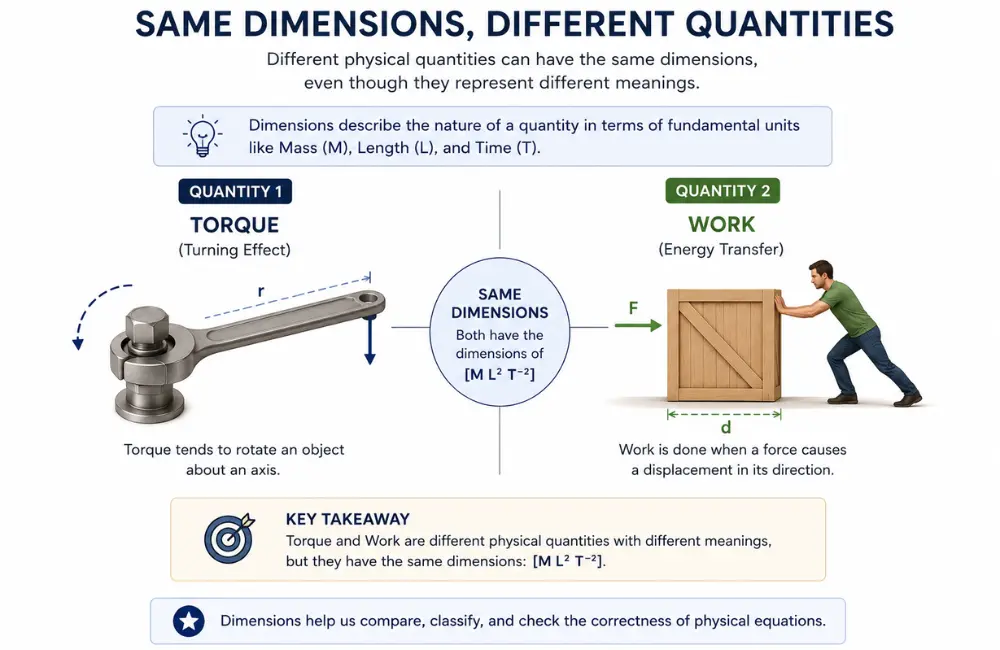
Two different physical quantities may differ in their formula for calculation, but still have the same dimensions and dimensional formula.
For example, image showing two different physical quantities, work and torque, both concepts are different, but they have the same dimensions [ML2T-2].
Other examples of quantities with the same dimensions are
- Momentum = [MLT-1] and Impulse = [MLT-1]
- Distance = [L] & Displacement = [L]
- Angular Momentum = [ML2T-1] and Planck’s Constant = [ML2T-1]
- Angular velocity = [T-1] and Frequency = [T-1]
- Speed = [LT-1], Velocity = [LT-1]
In our next topic, we’re going to study dimensional analysis. You will learn how dimensions and dimensional formulas can check if a calculation formula is correct and help us derive new formulas.
